
Action Paralysis
Get moving

“You can just do things.” — Sam Altman
“Just do it.” — Nike
“Do or do not.” — Yoda
“Scooby-dooby-doo.” — Scooby-Doo
You have an opinion, I certainly have an opinion, and so do countless others. As they say, opinions are like… things we all have. We are overflowing with them. Every day someone somewhere is publishing a manifesto on how the world should be reorganized, a blueprint for reform, an open letter declaring what must be done. Meanwhile the actual doing seems perpetually postponed, lost in a maze of frameworks and strategies and conceptual refinement. We are all so busy preparing to act that we never quite get around to it.
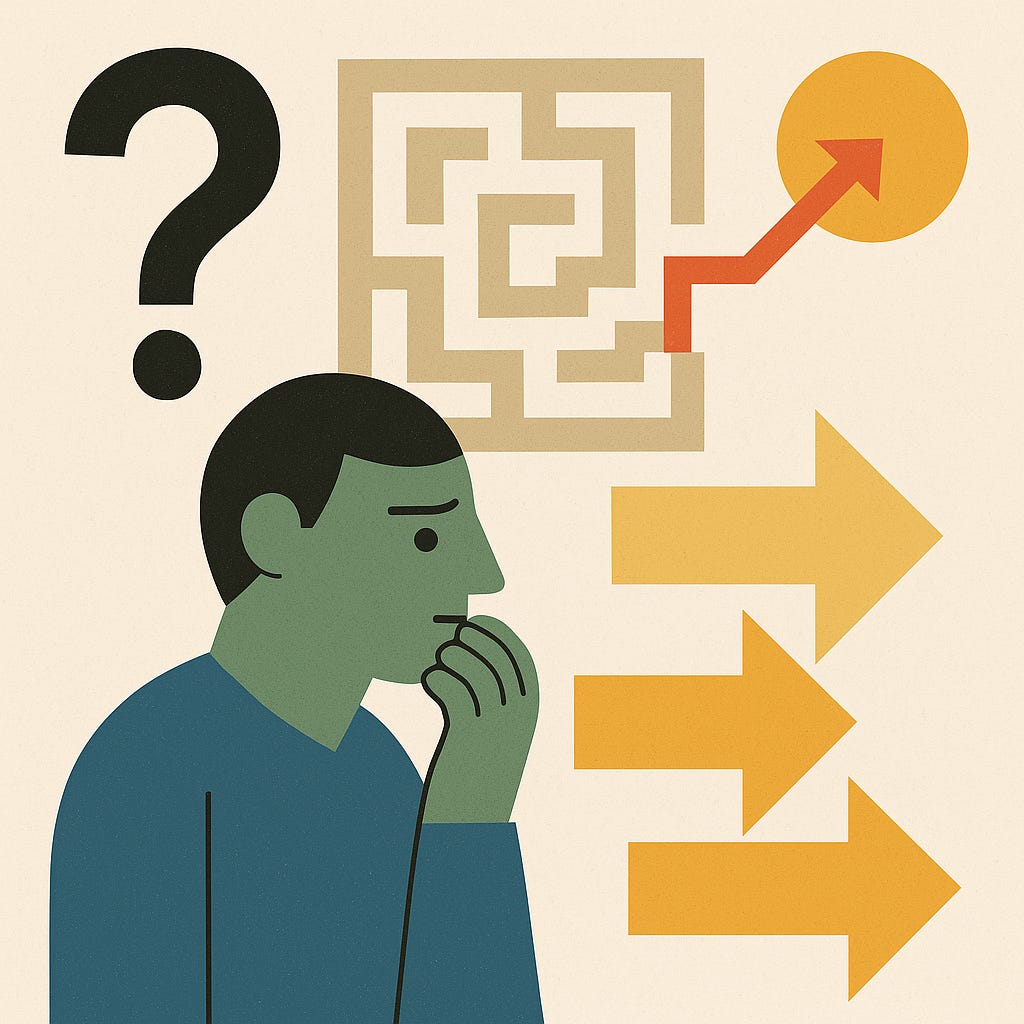
It is not that people are lazy or indifferent. It is that the world has convinced us that there is one perfect way to do everything, and that any deviation from that way will collapse the entire enterprise. We call this fear wisdom. We call it prudence. But often it is just indecision in dress attire. In reality, there are many paths to the same outcome. Different actions can lead to similar ends. There is no single golden staircase up the mountain. You can crawl, stumble, backtrack, or find a side trail that no one else noticed, and somehow still arrive where you meant to go.
Yet our culture has an allergy to imperfection. We think that before taking a step we must have the optimal plan. We compare, analyze, and benchmark until the moment of opportunity has quietly expired. I know people who have spent longer choosing the perfect productivity app than finishing the project it was meant to organize. We pretend this is preparation, but it is really a subtle form of avoidance. It feels safer to live in the warm glow of potential than the cold reality of execution.
Part of the paralysis comes from our worship of models. Everyone has one. Economists, technologists, activists, artists, even that one “friend” who insists he “sees the system, man.” We use these models to make sense of the world, but then mistake them for the world itself. A model is a tool for movement, not a temple to pray to. Once you start defending your model instead of testing it, you stop learning. The best thinkers are model agnostics. They understand that their understanding is partial, and they move anyway. They build, they test, they adjust. They do not wait for certainty because certainty never comes.
A friend once told me not to marry my spreadsheet. I think about that often. You can spend your life feeding numbers into cells, aligning columns of the hypothetical, but the moment you encounter reality it will refuse to cooperate. The world is not an equation to be solved. It is a conversation to be entered. And conversations require motion.
There is also the problem of mistaking consensus for coherence. We tell ourselves that everyone needs to agree before anything can proceed. We form committees, panels, working groups, coalitions, until what began as an act of creation becomes an exercise in risk management. Consensus can be a kind of comfort, but coherence is what actually matters. Coherence means your actions align with your values and your logic holds together long enough to generate momentum. Consensus is a handshake. Coherence is a pulse.
If you want proof, look at the Scooby Gang. They never waited for total agreement before running into the haunted mansion or confronting various goblins, ghouls, or ghosts. They had a kind of chaotic coherence. Fred had a plan, Velma had a clue, Shaggy had a sandwich. It worked, somehow. Every episode ended with the mask coming off. The lesson is not that luck favors fools, but that motion reveals what hesitation conceals.
We live amongst infinite drafts. There is always another alignment meeting, another pilot proposal, another framework for future action. I once saw a 40-slide presentation titled “Vision Alignment for Future Implementation Strategies.” It was a triumph of precision and a vacuum of direction. The energy that could have gone into doing was instead poured into perfecting the idea of doing. Yoda, in his Jedi way, cut through the noise. There is only do or not do. There is no “consider doing once properly scoped.”
If you want to unstick yourself, try this: do something small and wrong on purpose. Not reckless, just imperfect. Start the thing you have been overthinking. The first draft will be terrible, which is fine, because terrible is the gateway to possible. Or pick one model and then betray it immediately. It will remind you that theories are not prisons. Ignore consensus until coherence arrives. Agreement can wait. When in doubt, Scooby-dooby-do something. Run toward the haunted mansion. You might learn something about what is behind the mask.
Most outcomes are not ruined by acting. They are ruined by waiting. Motion generates feedback. Feedback generates learning. And learning makes the next action better.
The truth is that Altman, Nike, Yoda, and Scooby-Doo are all saying the same thing in their own peculiar dialects (some better than others). You can just do things. Just do it. Do or do not. And, of course, Scooby-dooby-doo. Each of these mottos points to the same principle: motion matters more than mastery. Doing creates information. Thinking alone creates dust.
We often tell ourselves we are waiting for the right moment, but there is no right moment, only the moment you choose to make right by entering it. The world rewards the mover, not because they are always correct, but because they are willing to discover correctness by bumping into it.
So move. Trip if you must. You can always change direction later. Coherence is not found at the start but built in the act of continuing. The meaning, as it turns out, is in the motion.
And if you need a mantra to carry you through the hesitation, choose whichever feels most honest to you. “Just do it.” “You can just do things.” “Do or do not.” Or the most predictably wise of them all: “Scooby-dooby-doo.”
Quite and enjoyable and educational read :)