
At Max Bet
Innovation and diffusion in the desert

“No man for any considerable period can wear one face to himself, and another to the multitude, without finally getting bewildered as to which may be the true.”
— Nathaniel Hawthorne, The Scarlet Letter
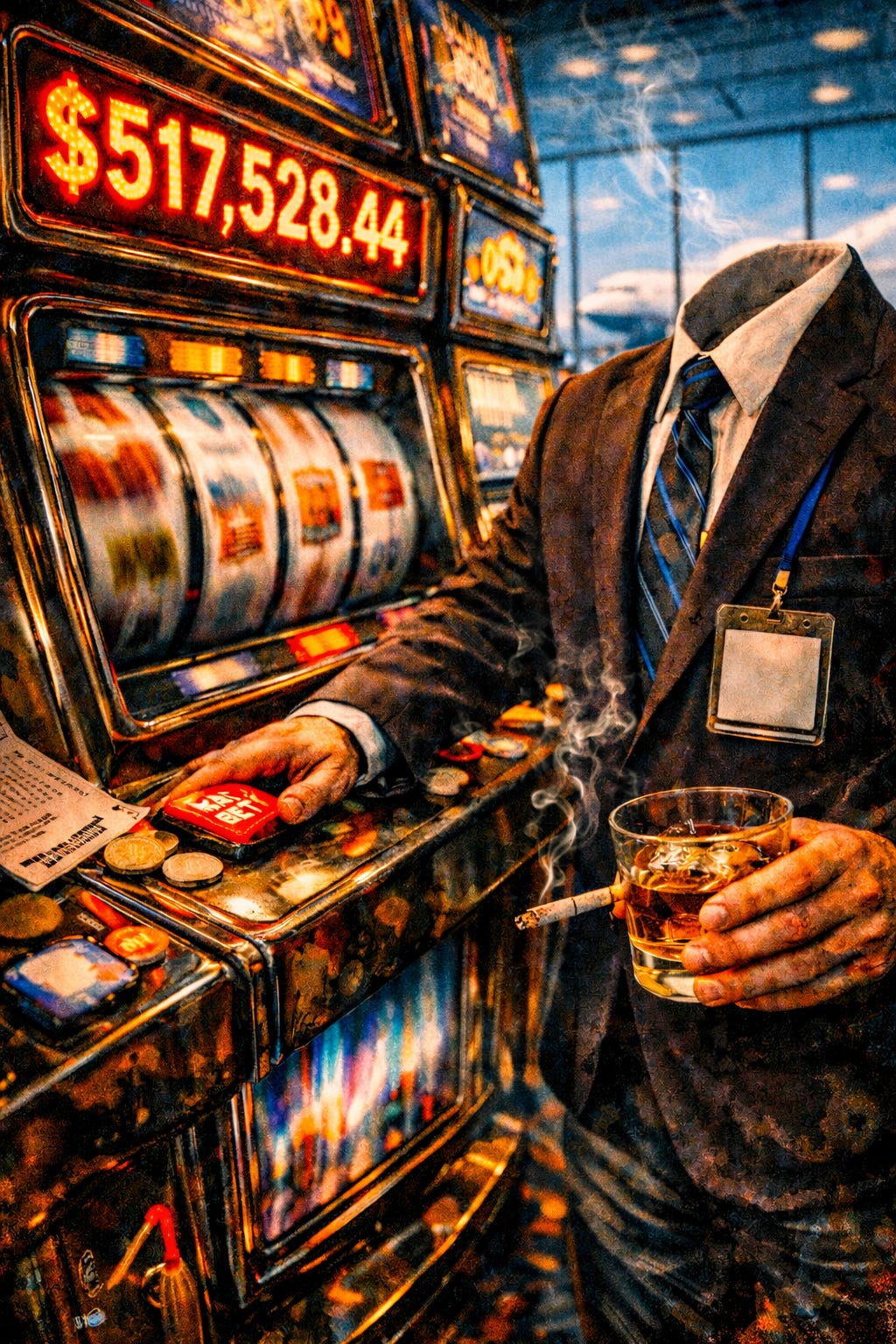
The jackpot counter reads $517,528.44 and it hasn’t moved. It never moves. That’s the point, the number has to be real enough to believe and unreachable enough to keep you in the chair. The wheel spins. Wheel of Fortune. Somebody thought that was funny, or didn’t think about it at all, which amounts to the same thing here, in the choke point between the plane and the city, where your defenses are down and your blood sugar is wrong and the light is the color of a migraine that hasn’t quite arrived.
This is how you enter Las Vegas. Not through a door. Through a threshold calibrated to remind you that the house already knows what you came for, and has made arrangements accordingly.
I am here for a meeting. One of those annual pilgrimages of people who work at the intersection of technology and medicine, a sector that has been promising revolution for so long that the promise itself has become load-bearing. There are a few hundred of us, all arriving through this same airport, this same gauntlet of spinning wheels and counters that never change, before dispersing into the city to talk about the future of healthcare. We have badge lanyards. We have sponsored happy hours with shrimp cocktail and a DJ nobody hired intentionally. We have a keynote, or several keynotes, in which someone standing in front of a very large screen will explain that we are living through a historic inflection point. This is true in the way that it is always true. The inflection point is a permanent condition of this industry. We have been at the historic inflection point for twenty-five years and the electronic health record still crashes on Tuesdays and nobody has figured out how to make a physician feel like the system was designed for them rather than around them.
I should say, before I go further, that I am not a neutral observer. I work in this space. My salary comes from the kind of institution whose logo appears on these conference banners. I have written documents that used the phrase “strategic alignment” without irony. I have attended previous versions of this conference and filled out the feedback survey at the end, rating the keynotes and the wifi and my overall satisfaction on a scale of one to five. I gave the wifi three stars. The wifi deserved two.
Through the tall windows behind the slot machines, the mountains sit in the particular stillness of things that have watched empires decide they were permanent. The desert doesn’t have a product roadmap. It is not in conversation with investors about what the next eighteen months could look like if the market cooperates.
My badge is in my bag. I haven’t put it on yet. I’m not ready to be found out.
The keynote speaker is a composite, which is to say he is real. He exists at every conference in this sector simultaneously, a man in his mid-fifties with the bearing of someone who has given this talk enough times to have stopped hearing it. He was in consulting, then in a health system, then in a company that was acquired, and now he is in thought leadership, which is the place you go when you have accumulated enough proximity to important decisions to seem authoritative without being accountable for any of them. He is talking about AI, specifically about what AI will mean for the clinician of tomorrow, a figure who appears in these keynotes with the regularity of a folk hero, always on the verge of liberation, always about to be freed from administrative burden by a technology that is, this time, genuinely different. The slides behind him show a physician looking at a screen with an expression of mild satisfaction. The physician is backlit. The physician has good posture. The physician has never, in any timeline, spent forty-five minutes on a prior authorization that was ultimately denied for a reason no one could explain.
Someone in the fourth row is nodding. I recognize the nod. I have produced that nod. It is the nod of someone who agrees with the general direction of a thing while privately cataloguing everything it leaves out, which is a skill this industry selects for the way Vegas selects for people who can lose gracefully and keep their card in the machine.
The expo hall is immense in the way that only conference expo halls and certain cathedrals are immense, that particular square footage designed to make you feel the scale of the enterprise you have joined by virtue of attendance. Every vendor has a banner. Every banner has a word on it. The word, this year, is intelligence. Sometimes augmented, sometimes ambient, sometimes just implied, a gravitational presence behind whatever the actual product does. The booths are staffed by people in company polos trained to ask questions before they explain anything, because asking questions is how you qualify a lead, and qualifying leads is the metabolism of this ecosystem. I know this because I have been qualified as a lead. I have also, at a previous version of this conference, been the person doing the qualifying, and I told myself at the time that my questions were genuinely curious. They were genuinely curious. They were also qualifying.
I stop at one booth because the demo is running unattended and I want to see what it does. It ingests clinical notes and surfaces recommendations. The recommendations are reasonable, the kind a careful clinician would make if the clinician had time to be careful, which is precisely the time the system is meant to restore, which is time that will be reinvested in seeing more patients, which will generate more notes, which the system will ingest. The wheel spins. A man in a polo appears at my elbow and asks if I have thirty seconds. I tell him I’m just looking. He scans my badge anyway. I let him, which tells you something about how the week is going.
The work I find genuinely urgent is happening somewhere else. Not secretly — it is largely public, largely published, findable if you know what you’re looking for. But it is not in the ballroom, not in the expo hall, not in the session I will attend tomorrow afternoon on change management strategies for AI adoption in ambulatory care settings, a session I have already half-written my takeaways for in my head. Whether that is efficiency or a bad sign I honestly cannot tell.
The people doing that other work are in different rooms, often smaller, often without shrimp cocktail, arguing about things that do not yet have product names. They are arguing about where moral responsibility lands when a consequential decision passes through enough layers of automation that the tired human at the end of the chain feels more like a formality than an agent. They are arguing about the difference between a system that supports judgment and one that quietly displaces the conditions under which judgment was ever practiced. These arguments will eventually arrive at this conference, translated several times over into procurement language and integration timelines, and something will be lost in translation the way something is always lost, and the question that matters is whether what survives is enough to justify having done it. I don’t know. I’m not sure anyone does yet. That is why the arguing continues in the smaller rooms while the expo hall hums with the confidence of people who have already moved past the question.
The frontier is the place where you still have to hold the question open. The conference is the place where holding it open starts to feel like a personal failing.
What I kept returning to all week was that the slot machine in the terminal was more transparent than most of what I encountered at the conference. As a structural observation, not a joke. The machine is a probabilistic engine dressed in the iconography of fate, deployed at the exact threshold where resistance is lowest, optimized through decades of behavioral research for a particular kind of surrender. It does not pretend to be neutral. Its incentive structure and its design are in perfect alignment, which means the alignment is at least understandable, legible.
What I watched in the expo hall was harder to read. The systems being sold there are mostly built by people who believe in them, deployed by institutions that mostly mean well, toward patients who mostly trust the arrangement has been thought through. And somewhere in that chain, the optimization target has a tendency to drift, quietly, toward the institution rather than the patient, toward throughput rather than the encounter, toward the metric that can be reported rather than the outcome that can be felt. Diffusion is not conspiracy. It is what happens when a technology strange enough to demand first-principles thinking becomes familiar enough to be handled by the procurement office. The extraordinary gets absorbed into the existing order without the existing order pausing to ask whether it was the right destination.
The slot machine is honest about the house edge. The question I could not answer this week is where, in the stack of systems being built and bought and integrated and optimized, the equivalent disclosure lives. Who tells the patient what the machine is returning, for whom, at what rate. At max bet, the wheel spins faster. The counter stays the same.
On the last morning I put the lanyard on before I left the room, which I hadn’t done any other day. The accumulated fatigue of moving through a large event had worn down whatever my hesitation was expressing and I just wanted to find the coffee without having to explain myself at the door. The badge tells the ecosystem what I am. The ecosystem responds accordingly: a nod at the session entrance, a scan at the booth, a lanyard-to-lanyard communion, recognition that we are both here, both inside, both part of the thing.
I am part of the thing, and have been long enough that I sometimes catch myself defending it in conversations where I intended to be critical, a specific kind of drift I notice the way you notice you’ve been holding your breath. The conference doesn’t make you complicit in anything dramatic. It makes you comfortable with the pace, the vocabulary, the particular horizon the expo hall implies, organized around what can be built and sold and integrated in the next eighteen months, which is a much shorter horizon than the moral questions actually require. The work I find most important refuses that horizon without abandoning the institution entirely, stays inside and asks uncomfortable questions from genuine proximity rather than clean-handed distance. I believe that. I also know it is a convenient thing to believe when you work where I work, and that the line between staying inside as a strategy and staying inside as an accommodation is not always visible to yourself from the inside.
Outside, on the last morning, I could still see the mountains from the taxi window, still doing the long slow work of becoming something else on a timeline that makes the conference feel like a rounding error.
My badge is in my bag. The counter probably still reads $517,528.44.
The wheel is still spinning. It doesn’t know I left.
A very nice antidote, (maybe even a vaccination!) to all the magical promises of the next new thing. These systems grind on of their own seeming volition. Inscrutable "hyperobjects" in Tim Morton's notion. Your mention of things "lost in translation" triggered a memory of this (long) poem which includes the glancing, hopeful note:
"But nothing's lost. Or else: all is translation
And every bit of us is lost in it"
James Merrill: https://www.blueridgejournal.com/poems/jm3-lost.htm