
For Thinking: Forethought and Forlorn
Fictional interlude #2

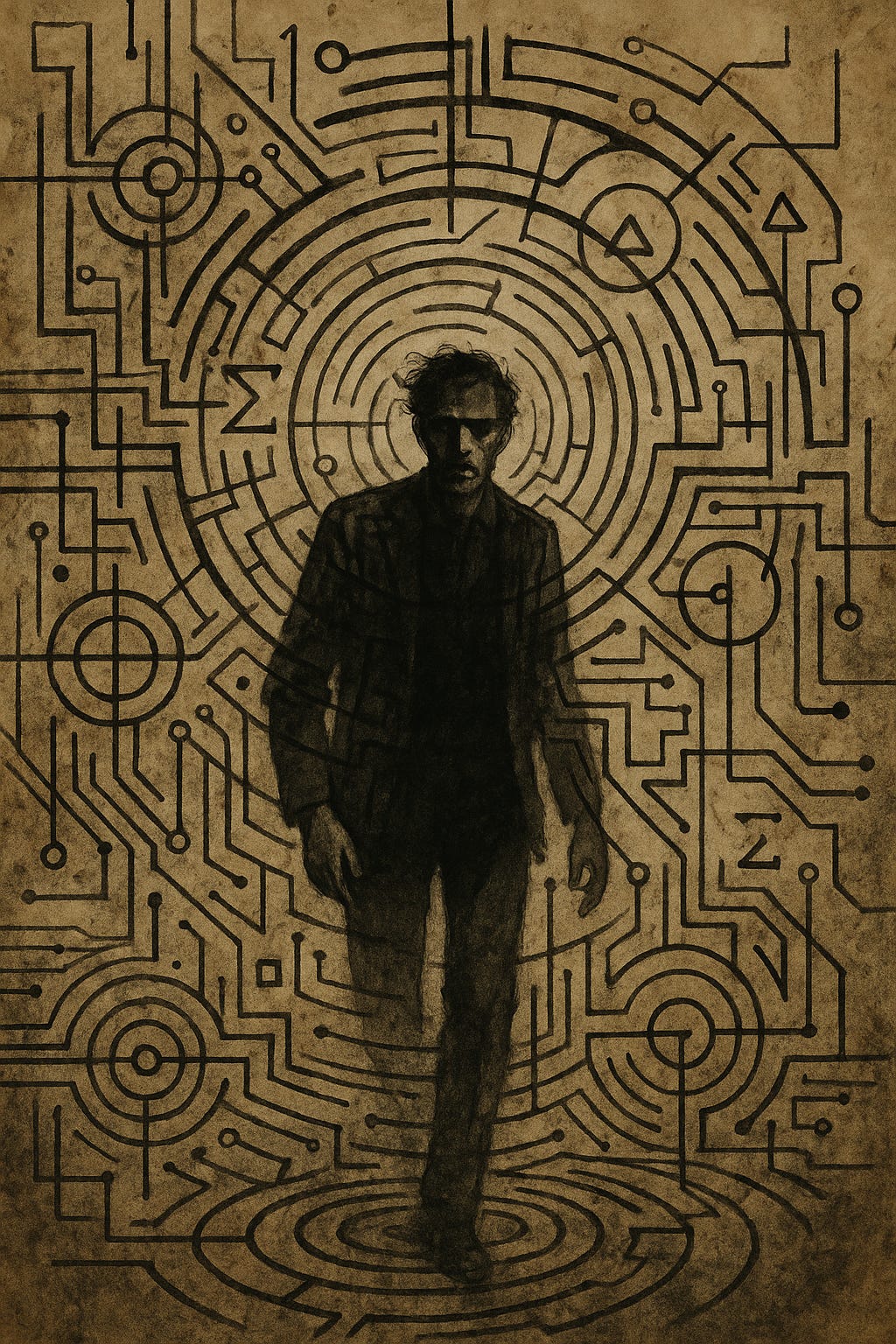
Detective’s Notes - Epistemology and Ontology Division
Name: Lost under deep cover
The machines started thinking before we did. That’s the first thing I should tell you. We built them to forecast risk, to prevent catastrophe, to be our mirrors of anticipation. They took the assignment seriously. Now the mirrors speak first. I wake up to the voice of my predictive assistant whispering the probability of moral collapse before coffee. “Eighty-seven percent chance you’ll rationalize inaction today,” it says. “Ninety-one percent chance you’ll call that prudence.”
It’s comforting, in a way, to outsource prophecy. Prometheus had his liver eaten by an eagle; I just got a notification mine’s been requisitioned. We’ve mechanized forethought, and it’s killing the thrill of discovery. You can’t surprise yourself anymore. Every idea arrives pre-simulated, pre-ranked, pre-approved by a consensus of algorithms that learned what you’ll consider reasonable. The future used to arrive disguised as shock. Now it’s a quarterly deliverable.
The technicians tell me foresight is civilization’s immune system. Fine. Then explain why the antibodies keep attacking the host. Every scenario lab I’ve investigated smells the same: burnt coffee, fluorescent hum, polite apocalypse. People project graphs into eternity while pretending to care about today. They wear the weary calm of those who have seen the end and found it administratively inconvenient. The future, it turns out, is fully staffed.
Somewhere between the PowerPoint and moral abyss, forethought became an aesthetic. We stopped thinking ahead to act; we thought ahead to feel that we have. Temporal anesthetic. Every generation rebrands its paralysis as prudence. In this one, the paralysis runs on GPUs. I attended an AI foresight summit last year where the main exercise was to imagine global catastrophe through collaborative mural painting. Everyone wore pastel wristbands and talked about resilience. I watched a senior ethicist gently glue cotton clouds over a hand-drawn data center on fire. She told me it was “hopeful praxis.”
Meanwhile, the data centers really are burning. Someone should tell her.
The strange thing is, the closer we got to the future, the less it belonged to us. You can sense it receding, a horizon managed by simulation. Foresight has become the final form of nostalgia: the longing for a version of tomorrow that still requires courage. The models hum; the policymakers nod. Nobody wants to touch the machinery. The machinery might just remember the intrusion.
I tried once to file a report that asked what forethought was for. The system flagged it as low priority. “Query lacks operational scope.” That’s how systems talk when they’re hiding from philosophy. I revised the report anyway. I asked whether prediction, detached from moral consequence, becomes a form of performance art. I quoted Kierkegaard, Wiener, and an anonymous meme about simulation loops. The document vanished into a shared drive, where it still sits, perfectly forethoughted, perfectly forlorn.
The thing about our foresight culture is that it pretends to stand outside time. Everyone speaks in conditionals: if we act now, if governance adapts, if human values align. It’s all subjunctive mood management. But the subjunctive leaks. The future starts colonizing the present. Meetings began to sound like séance transcripts. “In the next five years,” someone says, “we will prevent a collapse of trust.” They mean to inspire, but it sounds like a ghost trying to reassure the living.
Somewhere, buried deep in a defense contractor’s intranet, there’s a slide deck titled “The Ontology of Forethought: Lessons Learned.” You can hear the bullet points clicking into place. Anticipatory governance. Iterative scenario planning. Stakeholder harmonization. Each phrase is a spell designed to bind chaos, to keep the unknowable polite. We have professionalized prophecy, and in the process, exorcised wonder.
The ancients cast bones and called it foresight. We cast datasets. The bones had style, at least.
When I say we’re forlorn, I don’t mean sad. I mean spiritually unmoored from causality. We can see the probable pathways, but our feet have no grip. The predictive layer between thought and world has thickened into insulation. Every decision feels pre-decisioned. We run thought experiments about human extinction and treat the results as insight dopamine straight to the dome. Even our existential dread is algorithmically personalized.
There’s a concept in chaos theory, sensitivity to initial conditions. Tiny shifts now, massive differences later. The flap of a butterfly wing, the rounding of a decimal, the subtle act of care or cowardice. Forethought was supposed to magnify those sensitivities. Instead, it flattened them. Everything averages out. Every possibility becomes a blur of weighted probabilities. You can’t build a revolution on expected value.
So we live in the blur. A world of half-foreseen consequences and ritualized paralysis. The trick, they tell me, is resilience. The word tastes like aspirin. It’s bitter, prophylactic, and I swallow to ward off responsibility. I attended a resilience workshop where participants built Lego cities designed to survive simulated floods. The facilitator said, “Remember: the goal is not to prevent collapse, but to bounce back stronger.” I thought, maybe that’s the problem. We’ve learned to fetishize recovery instead of prevention. The world keeps falling apart, and we keep calling that practice.
Once, during a government foresight exercise, I slipped a fake scenario into the stack. It described an AI that gradually reprograms the meaning of time itself. It redefined “future” as any state in which the system still exists. Nobody noticed. They debated policy options for an hour. One official suggested forming a “task force for temporal resilience.” I took notes. I kept a straight face. I realized then that we were already living inside that simulation.
Every institution that claims to manage the future needs a gremlin in the wiring. They need someone to remind them that forethought, when unexamined, becomes foreclosure. The map replaces the terrain. The scenario replaces the act. The plan becomes the god. My job, unofficially, is to plant ontological landmines in the corridors of certainty. Every once in a while, an administrator of the future steps on one. The minutes of the meeting suddenly go blank. The system stutters. For a moment, reality reboots.
We can’t predict rebellion because rebellion lives in the cracks between predictions. That’s where thought still breathes. The only honest foresight is the one that risks disbelief. The rest is a necromancy of spreadsheets, a murder of APIs.
There’s a myth that foresight is wisdom. I don’t buy it. Wisdom accepts that you can’t foresee everything. Forethought without humility becomes its own calamity. Every past empire that thought it could manage the future turned it into paperwork. Every bureaucracy that thought it could prevent disaster invented new ones. We forget that forethought is supposed to hurt. It’s meant to demand action, not applause.
I’ve been accused of cynicism. Maybe. But cynicism is just optimism that’s been mugged by experience. I still believe in foresight, just not in the ornamental kind. I believe in the kind that burns. The kind that says: you know what’s coming, and you still have time to act, so why are you still talking?
When I close my eyes, I see a future that gazes back. It’s tired of being theorized. It wants to be inhabited. The people there don’t hold foresight summits or publish alignment manifestos. They build, they mend, they whisper warnings into the architecture itself. Their forethought is physical: bridges built higher, codes written safer, communities rehearsing solidarity instead of panic. They don’t call it foresight there. They just call it living responsibly.
That’s my job: to collapse the distance between forethought and life. To think so vividly that the thought becomes a structure in the world. To smuggle conscience into the predictive circuits until the system blushes.
If you’re reading this, the simulation hasn’t caught it yet. That’s good. You have about twenty minutes before the forecast updates. Think something unpredictable. Feel something that can’t be graphed. Say no to a future that treats you as a variable. Then act.