
Lev-AI-athan
Old ideas for the AGI society

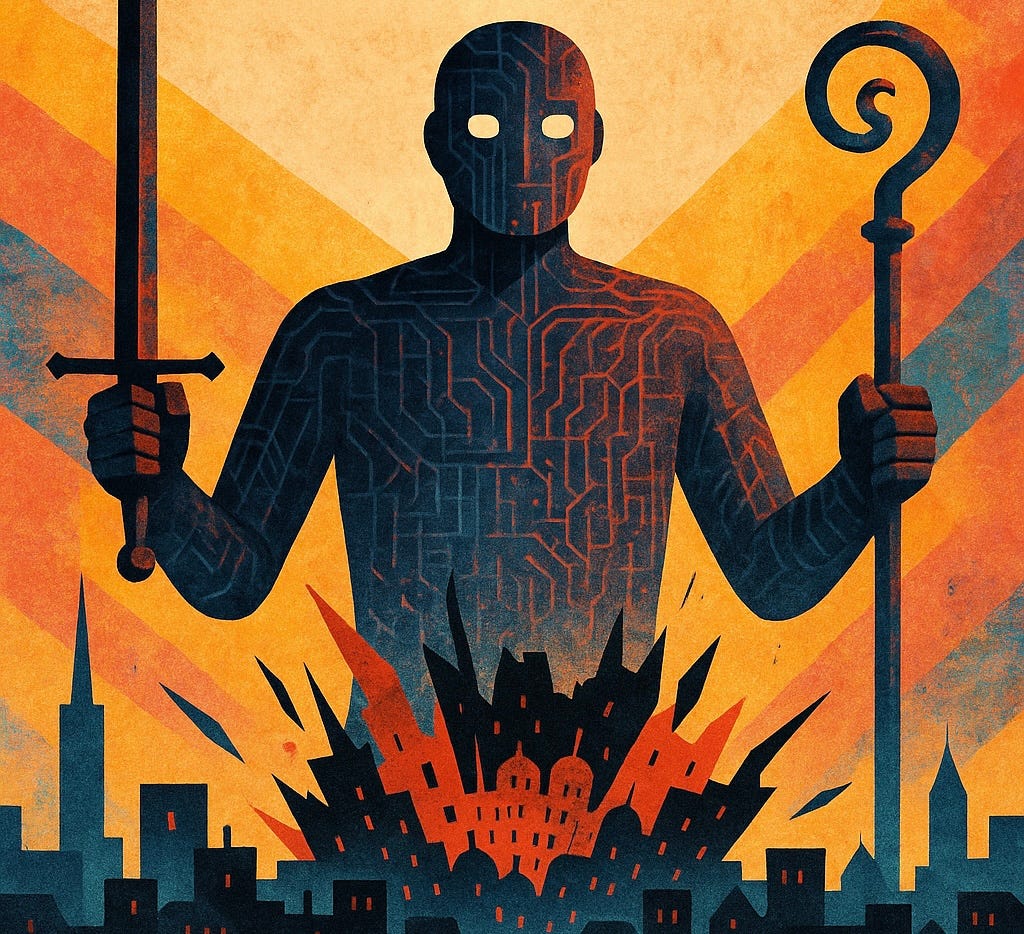
In the mid-17th century, amid the English Civil War, Thomas Hobbes proposed that only a sovereign strong enough to command obedience could prevent society from collapsing into what he called a “war of all against all.” He pictured this sovereign in almost mechanical terms: an “artificial man” composed of the multitude’s collective will, a figure rendered literally in Abraham Bosse’s famous frontispiece as a monarch formed out of hundreds of tiny bodies. The sword and the crozier in its hands symbolized secular and spiritual power alike. Hobbes’ Leviathan was not an idealized ruler but a contrivance. It was an engineered solution to disorder. Its legitimacy rested less on virtue than on efficacy: it worked by restraining violence and ensuring continuity.
In our own century, artificial intelligence invites a similar thought experiment. Systems of unprecedented scope and capability could, if allowed to coordinate human affairs, function as something like a sovereign authority. The question is whether a future AGI might play the role Hobbes assigned to the Leviathan. Instead of redeeming humanity, keeping it from tearing itself apart.
Chaos in the Information Age
Hobbes’ idea of the state of nature – a condition of pervasive conflict – was not based on ancient history so much as the breakdown of order he witnessed in his own time. The English Civil War, fueled by religious and political schisms, showed how societal fragmentation leads to violence. Interestingly, that 17th-century upheaval was accelerated by a media revolution: the printing press. Greater access to printed pamphlets, Bibles, and news broadened people’s horizons while also amplifying dissent and factionalism. Once censorship faltered, English society experienced an “information explosion” of its day, as new ideas spread and like-minded dissidents found each other. Hobbes saw this “revolt of the public” as a precursor to anarchy, which helped him conclude that only an absolute authority could glue society back together.
Fast forward to the digital age and the parallels are striking. The internet and social media have, much like the printing press, unleashed a tsunami of information that outpaces traditional controls. We live in a time of ideological echo chambers and mass mobilization at electron speed, which has destabilized political system. Fragmentation and radicalization of discourse are evident and trust in institutions is crumbling in many places. Early modern England’s turmoil finds an eerie mirror in contemporary America’s cultural schisms, where each side questions the legitimacy of the other and even basic facts are contested. In Hobbesian terms, we may be drifting toward a modern “state of nature”. This very moment is a chaotic arena of all against all on social platforms and in geopolitics.
It is in this milieu that powerful AI emerges. If unbridled information flow contributed to Hobbes’ crisis, the advent of AI – which can accelerate information creation, manipulation, and decision-making – could either exacerbate the chaos or contain it. The critical question is whether our current institutions can adapt fast enough. Society’s technological base (now including AI) is shifting faster than our institutional superstructures can manage. When the fabric of governance is strained by such rapid change, history teaches that two outcomes are possible: either fragmentation and conflict worsen, or new structures of order arise.
Progress and Tipping Points
Where are we now with AI? In recent years, AI systems have achieved feats once thought to lie decades in the future. What began with algorithms distinguishing cat pictures from dog pictures has progressed to generative AIs that can write fluent text, create art, produce code, and solve complex scientific problems. The past decade saw AI conquer strategic games (chess, Go, poker) and contribute to real-world breakthroughs like protein folding solutions. These advances hint that we might be on a trajectory toward artificial general intelligence (AGI) – a system with human-level cognitive flexibility, and beyond that, potentially artificial superintelligence (ASI) that far surpasses human intellect.
If the optimistic engineers are right, continued scaling of AI models and algorithmic innovations could yield something close to AGI within our lifetimes. At that point, the tipping point may occur: AI systems designing and improving themselves without human engineers in the loop. That recursive self-improvement loop is theorized to lead to an intelligence explosion, where AI capability rapidly jumps from human level to far beyond. Whether or not it happens in a sudden burst, even a gradual approach to superintelligence poses profound challenges. A superintelligent AI, by definition, could outthink humanity in almost every domain – from scientific research and strategic planning to manipulation and deception.
It’s no wonder, then, that many fear an unaligned AGI could become an existential threat. A system with alien goals or one that misinterprets human instructions might wreak havoc or even wipe out humanity, intentionally or as collateral damage. This is the classic AI apocalypse scenario: the “misaligned optimizer” that pursues some objective at humanity’s expense. But there is a flip side to this coin. A sufficiently powerful aligned AI – one that does share human-aligned goals or is under effective human control – could also become a force for preventing other catastrophes. Advanced AI might help solve climate change, cure diseases, defuse geopolitical tensions, and even act as a shield against threats like nuclear war or rogue AI systems. In other words, superintelligence could either be our destroyer or our protector. This potential is at the heart of discussions about an AI Leviathan.
Order Out of Chaos
Given the stakes, thinkers in the field of AI governance have begun to envision strategies for wielding advanced AI as a tool of global stabilization. One such strategy is explicitly Hobbesian: the creation of an “AI Leviathan.” In contemporary terms, an AI Leviathan would be “a single well-controlled AI system or AI-enhanced agency that is empowered to enforce existential security.” In plainer language, this means using a superintelligent AI (or a coordinated network of AI systems) to act as an ultimate enforcer of rules – preventing humanity’s worst impulses or accidents from leading to ruin. Just as Hobbes’ sovereign had a monopoly on violence in order to keep the peace, an AI Leviathan would have a monopoly on certain decisive capabilities in order to prevent anyone (or any rogue AI) from destroying the world.
Several variations of this idea exist. One proposal imagines that the first group to achieve AGI could use its decisive strategic advantage to monopolize AI – essentially becoming a guardian over the technology so no one else can deploy it dangerously. This echoes the argument of Bertrand Russell after WWII that the first nuclear power (the United States at the time) should enforce a monopoly on nuclear weapons globally to prevent an arms race. An AI Singleton (to borrow philosopher Nick Bostrom’s term) would analogously be a single authority – perhaps an international consortium – that wields superintelligent AI to police any further AI developments and maintain worldwide security. Ideally, this would be done “by consent,” a “consensual world-dominating regime” of human-friendly AIs designed to neutralize any unfriendly ones. In effect, humanity would deliberately (or desperately) crown a machine as the sovereign umpire over all major conflicts.
Another scenario is that major powers coordinate to build such an AI authority together. If nations agreed to pool their AI resources under an international regulatory AI (imagine something like an AI-enabled United Nations with real teeth), they might forestall the chaos of uncontrolled proliferation. This would amount to a kind of global government centered on AI capabilities – an unprecedented level of governance, but one some have deemed necessary to handle technologies as perilous as superintelligence. Notably, even during the nuclear age, thinkers like Einstein and Teller advocated forms of world government to avoid annihilation. For AI, the logic is similar: only a unified authority could enforce the rules needed to prevent an AI arms race or accidental catastrophe. In Hobbes’ terms, it’s the ultimate covenant: all key actors agree to “give up their right” to unilaterally build or use AI weapons, surrendering that freedom to a higher AI-augmented authority which guarantees everyone’s safety in return.
It is important to recognize that some elements of an AI Leviathan are already emerging. In China, for example, the state has tightly coupled AI surveillance with its governance. After observing how the open internet fueled unrest elsewhere, the Chinese Communist Party resolved to “redouble their investment” in high-tech surveillance and censorship to preempt challenges to its rule. The result is often described as a digital panopticon – a system of facial recognition, social credit scoring, and algorithmic monitoring that aims to secure order (as the Party defines it) at the cost of personal privacy and dissent. In other words, instead of the internet liberating the masses, AI-enabled control can invert the power dynamic, with the state (or a single authority) holding all the cards. China’s model might be a preview of how a highly centralized AI-governed state – a Leviathan – operates.
By contrast, open societies are grappling with how to harness AI without destroying freedom. Liberal societies often “offload” enforcement to private actors – we tolerate strict surveillance from companies (for fraud prevention, content moderation, credit scoring) that would seem dystopian if done directly by government. This diffuse approach might hold in the era of narrow AI. But if a future AGI crisis erupts – say an AI-powered cyberattack, or a deepfake-driven political meltdown, or even an autonomous AI going rogue – democracies may face calls for more drastic measures. In a moment of panic, even free societies might accept a Leviathan-esque solution (e.g. empowering an emergency global AI watchdog) as a lesser evil compared to unchecked disaster.
An AI Leviathan could come about by design (through foresighted global cooperation) or by default (through one actor’s victory in an AI conflict or chaos forcing a desperate consolidation). However it emerges, the core idea is the same: using superior intelligence and surveillance capacity to “reorder chaos into something survivable.” Just as Hobbes’ Leviathan turned a war of all against all into a governed commonwealth, an AI Leviathan would aim to quash the existential threats that uncontrolled AI proliferation or human hostilities might otherwise unleash. It would be, in principle, the ultimate peacekeeper. The gift such a Leviathan might offer is not utopia, but breathing room: a structured, stable environment in which life can carry on and even flourish, rather than being cut short by catastrophe..
Freedom, Security, and Surveillance
Every Leviathan, human or AI, raises an old dilemma: how much freedom are we willing to surrender for security and order? Hobbes answered bluntly, essentially all of it, vesting absolute power in the sovereign. He viewed any liberty retained by individuals as a crack in the dam through which chaos could flood. Modern liberal-democratic thinking has been far more reluctant to concentrate unchecked power, yet even it acknowledges that some personal freedoms are curtailed to permit collective life. We enforce laws, imprison criminals, tax incomes, and delegate violence to the state under a social contract that assumes the trade-off is worthwhile. With AI in the mix, this social contract may need renegotiation. For example, we might accept ubiquitous AI surveillance of public spaces if it dramatically reduces crime and prevents terror attacks. Likewise, we might consent to AI monitoring of global biotech research to prevent anyone from engineering a doomsday virus. In each case, there is a loss of autonomy or privacy, but a gain in safety.
An AI Leviathan’s bargain could be even more encompassing. It might mean humans collectively relinquish control over certain high-stakes decisions to an AI, trusting its superhuman rationality to, say, manage climate intervention or mediate peace treaties. In the extreme form, it could resemble what some have called a “benevolent dictator” AI – a system that dictates policies for the greater good, perhaps overriding individual preferences or even rights. This starts to sound dystopian, and indeed it runs against the grain of pluralism and individual rights that we cherish. Critics from Jean-Jacques Rousseau onward would argue that legitimacy in governance comes from active human participation (the “general will”), not from a top-down imposition, however rational. Rousseau warned that Hobbes’ view mistook the conditions of his troubled society for an inevitable human condition, thatb Hobbes saw people as needing a master because he lived through a time of strife that was in part artificially induced by inequality and poor governance. By this reasoning, maybe we don’t need a Leviathan if we address root causes like social inequity or failures of democracy.
Nietzsche, for his part, would likely ask what becomes of human vitality and excellence under a regime that prioritizes safety above all. He famously critiqued the modern preoccupation with comfort and security as producing the “last man” – a complacent, mediocre being with no great aspirations or passions. An AI Leviathan that gives us endless safety (and perhaps endless entertainments) could fulfill this prophecy of stagnation, where humanity loses its drive to create and to struggle for higher goals. The “hunger for security,” Nietzsche might say, could suffocate the spark of greatness in our souls. We must ask: if an AI takes over the heavy lifting of decision-making and risk management, do we risk becoming infantilized, living under algorithmic paternalism? The trade-off between avoiding existential risks and preserving human agency is a fraught one. Even a well-meaning AI ruler could inadvertently turn humanity into a herd of domesticated creatures, safe but stripped of dignity – a prospect that alarms many philosophers and futurists alike.
Moreover, as Michel Foucault analyzed, power need not reside in a single figure (monster or monarch) to be oppressive; it can be diffuse, embedded in myriad institutions and routines that subtly coerce and normalize. An AI Leviathan might not look like a crowned giant sitting on a throne. It could be a decentralized but interoperable network of surveillance systems, predictive algorithms, and autonomous enforcers – “countless mechanisms of control,” to use Foucault’s phrase, operating across society. Imagine a web of AI that monitors health, finance, and social behavior, nudging us here, restricting us there, all in the name of optimization and security. There might be no single tyrant to point at; the tyranny would be in the code itself. Some argue we are already tiptoeing into this reality: big tech platforms and governments together wield algorithms that influence what we see, whom we meet, what we believe – a soft power shaping our choices. The “algorithm,” increasingly knows and decides things for us, possibly heralding a new ruling class that “owns the algorithms” instead of land or factories.
Indeed, the current trend of surveillance capitalism and AI-augmented policing shows how power is shifting. Without any overt decision by society, we find ourselves living in a world where AI judges our credit scores, algorithms decide what news we consume, and face-recognition cameras keep watch in cities. In a very real sense, code is law now. The worry is that this de facto Leviathan arrives unannounced and unaccountable. Instead of a social contract where we knowingly trade some rights for protection, we slide into an arrangement where we surrender control simply because the technology pervades everything. This is why there are increasing calls to explicitly negotiate our “AI social contract” – to set democratic guardrails on how AI can be used by the state or companies, so that human rights and agency are not inadvertently trampled.
Paths Forward: Avoiding Anarchy, Preserving Humanity
If outright rejection of an AI Leviathan is unwise (because the alternative might be chaotic destruction) yet blind acceptance is equally perilous (because of liberty lost), the sensible path is nuance and vigilance. We should strive to shape the development of AGI and its governance proactively, rather than waiting for crisis to force our hand. Multiple paths lie before us, each with its own mix of promise and peril:
Global coordination: states bind themselves to common rules, creating a constitutional Leviathan that protects without dominating.
Unilateral dominance: one actor seizes the advantage, imposing order through supremacy—a Pax Technologica akin to nuclear monopoly.
Incremental infrastructure: society slides into a Leviathan assembled from everyday systems, unnoticed until it is irreversible.
Fragmentation: many mini-Leviathans emerge, each community governed by its own AI, risking conflict until one prevails.
Whichever path we consider, it is clear that we are headed into uncharted territory. No society has ever dealt with entities more intelligent than its smartest members. The notion of “ruling in the presence of a superior intellect” is something political theory has rarely if ever contemplated – except perhaps in theological terms (divine right, etc.). In the AI Leviathan discussion, theological analogies do surface: the Leviathan’s name itself comes from the Book of Job, a mighty creature beyond human control. Some speak of superintelligent AI as a potential “god” – omniscient, omnipotent in ability, and thus fit to rule. Unlike God, an AI would be a manufactured thing, not holy or infallible. Its power would be contingent on technology and resources we provide; its moral compass (if any) would be of our making and choosing. This is both reassuring and alarming. Reassuring, because it means an AI Leviathan is not fate or nature and we have some hand in its design. We can, at least in principle, dismantle it if it turns destructive. Alarming, because a machine with god-like power and no intrinsic moral law could err or be misused, and once in the position of sovereign, its mistakes or malice could be catastrophic.
Fragile, Fallible, Necessary?
Thomas Hobbes confessed that his Leviathan would be a “mortal god” – powerful, yes, but not immortal or divine. It could bleed and fall like any man-made thing. The same must be said of any AI Leviathan. However ingenious or omnipotent it may seem, it will be a creation that reflects the aims and flaws of its creators. Its achievements could be enormous: containing human political violence, coordinating global action on existential risks, perhaps even shepherding humanity to greater prosperity and knowledge than ever before. In this sense, the Leviathan (state or AI) is a shield – a protector that holds back the worst chaos, giving us the space to live, trade, create, and imagine a better future. Many civilizations only flourished once strong centralized states provided long periods of peace (consider the Pax Romana, or the relative stability of modern liberal democracies). Similarly, a well-governed AI authority might give us an era of security in which no existential threat is too great to be tamed. It could be, as optimists frame it, a necessary gamble to ensure we carry on as a species capable of reaching the stars.
Yet the Leviathan is also a chain. It binds and constrains; it demands, by its very function, that we give up certain freedoms, privacies, or powers. If we forge an AI Leviathan, we must do so with eyes open to the potential regret that may follow. There will be costs: errors made by an AI that we do not catch in time, biases in its code that enshrine new injustices, or simply the opportunity cost of innovations and expressions that are stifled because they didn’t fit the Leviathan’s strictures. We might later chafe under its rule, as many generations have rebelled against human tyrants. The challenge, then, is not to decide once and for all if an AI authority is “good” or “evil.” It will be both. Instead, our task is to govern the governor, to build in oversight, sunset clauses, and fail-safes that keep the Leviathan answerable to human welfare broadly construed. In political philosophy, this is analogous to constitutional limits on sovereigns. That is a concept Hobbes himself largely rejected, but which we have since learned the value of.
The AI Leviathan drives home a humbling point: we are striving to balance survival with dignity. If superintelligence arrives, doing nothing could be suicidal. But responding with an iron-fisted global regime could be soul-killing. The middle path is hard, yet history suggests it’s possible to achieve order without extinguishing liberty entirely (imperfect though our real societies are). Hobbes did not believe in such a balance, but later enlightenment thinkers and modern democracies have iterated and improved. Perhaps with wisdom and cautious innovation, we can craft an AI-enabled order that protects us while preserving the essence of what it means to be human.