
Meditations in a Shutdown
Emptiness, contingency, and you

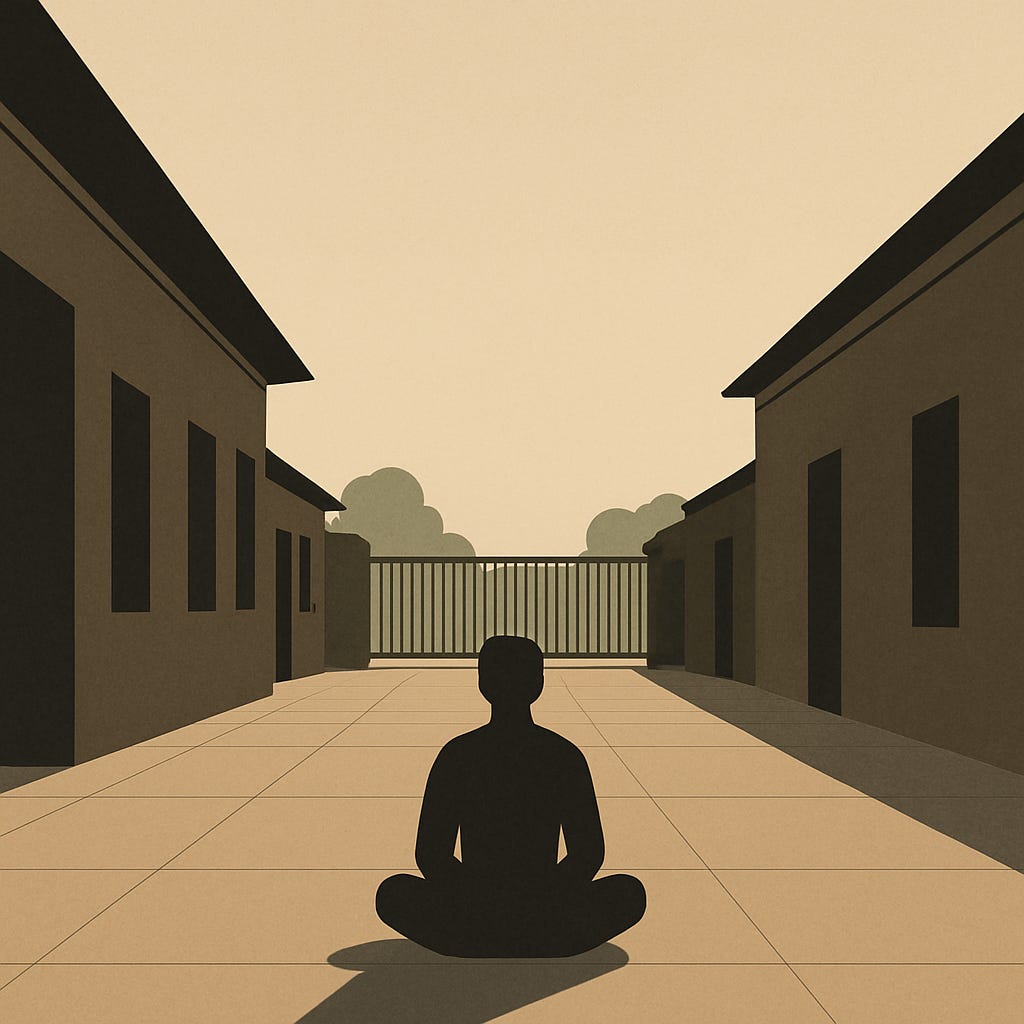
A shutdown is not the kind of crisis that draws headlines with images of fire or flood. It is bureaucratic and strangely domestic. Offices close, parks are locked, projects are suspended, and salaries stop arriving. The machinery of governance halts not because of external disaster but because the internal gears jam. To those outside its orbit, a shutdown might appear as a political game, another move in the ceaseless contest of partisan strategy. But for those inside it, the shutdown is lived as interruption. Many feel motionless, but around them plans dissolve, paychecks are delayed, and anxiety creeps in with each passing day.
The disorientation lies not only in the loss of function but in the loss of continuity. Shutdowns reveal, with unsettling clarity, that what we take as solid and stable is in fact fragile. A government agency that seemed permanent yesterday ceases to operate today. The assumption of continuity, so deeply woven into the rhythm of life, evaporates. What remains is the realization that institutions are contingent, dependent on agreements and conditions that can, do, and will again fail.
The United States has seen this lesson many times. In 1995–96, a standoff between President Clinton and a Republican-led Congress closed government offices for a combined 27 days, the longest shutdown until 2019. In 2013, disputes over the Affordable Care Act forced a 16-day halt, during which more than 800,000 federal employees were furloughed. Scientists at the CDC and NIH had experiments interrupted midstream. National parks closed, costing local economies millions in lost revenue. In 2018–19, the government entered its longest shutdown in history—35 days—affecting 420,000 federal workers who were forced to work without pay and another 380,000 furloughed. Stories emerged of TSA agents calling in sick en masse, of Coast Guard families seeking food pantries, of research projects losing irreplaceable time-sensitive data. These episodes illustrate a truth many would rather ignore: institutions that feel immovable can, in practice, stop overnight.
Such recognition is not just political but philosophical. It echoes ideas articulated nearly two thousand years ago by Nāgārjuna, the Indian philosopher who founded the Madhyamaka school of Buddhist thought. Nāgārjuna argued that no phenomenon has an inherent, independent essence. Everything that exists does so because conditions align; when those conditions change, the phenomenon disappears. This is the meaning of śūnyatā, or emptiness. It is not nothingness, but, instead, contingency. To call something empty is to recognize that it exists relationally, not autonomously. Institutions are no exception. The shutdown is a lived demonstration of emptiness: the government’s continuity depends on agreements, funding, and function, and when those conditions fail, the government falters.
When confronted with such disruption, most people oscillate between two extremes. On one side lies despair, the conviction that collapse signals something permanent, that nothing will recover. On the other lies denial, the insistence that the shutdown is a temporary annoyance, unworthy of reflection, because “things will go back to normal.” Nāgārjuna cautions against both. The shutdown is neither the end of the world nor a trivial hiccup. It is a disruption that reveals the conditional nature of the systems we rely upon. To meet it with clarity requires refusing both despair and denial.
This refusal is more than a philosophical flourish. It has practical consequences. Shutdowns strip away routines and roles we confuse with permanence. The deadlines, commutes, and office hierarchies that define our sense of identity fall silent. What remains is openness. It is uncomfortable, but also instructive. Emptiness, if misinterpreted, can feel like void, the terrifying sense of nothingness. But emptiness properly understood is openness: the possibility of seeing anew. A shutdown gives us the chance, however unwillingly, to ask which parts of our lives are truly essential. It reveals that much of what we cling to is scaffolding, useful but not absolute.
The lesson beneath all of this is interdependence, even for those not directly affected. Shutdowns ripple outward: a furloughed worker misses a paycheck; a family delays paying bills; a local economy suffers from lost spending; contractors, suppliers, and communities feel the strain. Services halt, and people reliant on them must adjust. What appears at first to be a political standoff in Washington becomes, in reality, a networked disruption across society. This is the point: emptiness is inseparable from interdependence. To say things are empty of inherent essence is to say they exist only through connection. The shutdown forces us to see those connections in sharper relief than continuity ever does. Evidence in absence; absence as evidence.
From this recognition flows compassion. Compassion is not, in this context, sentimental or optional. It is simply a clear response to the reality of interdependence. If our lives are intertwined, then another’s vulnerability is also our own. Shutdowns tend to isolate people in their anxiety, each person fearing they are uniquely burdened. Compassion cuts through this illusion. To recognize that vulnerability is shared is to take the first step toward collective resilience. Compassion in practice might mean reaching out to a struggling colleague, supporting community food programs, or simply refusing to interpret another’s pain as separate from one’s own. In Madhyamaka thought, wisdom and compassion are inseparable: to see emptiness clearly is to feel compassion inevitably.
Meditation, in the broad sense, is the practice of paying attention to what the shutdown reveals. It does not mean retreating from difficulty but sitting with it. The restless mind craves certainty: “When will this end? How will I make it through?” Meditation is the discipline of noticing that craving, and noticing too that certainty never arrives. Clarity, then, is not the product of stability but of recognizing that stability is never more than provisional. To meditate on a shutdown is to see that peace need not wait for continuity to be restored. It can be cultivated in uncertainty itself.
This insight extends beyond the federal government. There are many kinds of shutdowns in human life. The loss of a job, the onset of illness, the collapse of a relationship, the caregiving responsibilities that force a pause in a career—each a kind of suspension, a breaking of continuity. They carry with them the same temptation toward despair or denial. And they carry the same opportunity: to see that stability is contingent, that identity is more than role, that interdependence is real. The lesson of the shutdown applies across scales, from nation to household to individual life.
Of course, recognizing these lessons does not eliminate the real harm. Shutdowns hurt. Families struggle to pay mortgages; researchers lose irreplaceable data; communities dependent on federal programs are left vulnerable. To suggest otherwise would be cruel. The point is not to celebrate shutdowns but to learn from them. They remind us of truths that continuity conceals: institutions are provisional, systems are interdependent, compassion is necessary. To live as though these were not the case is to live in illusion.
What, then, is the practical conclusion? I posit this: peace of mind cannot be outsourced to institutions, because institutions themselves are fragile. If our well-being depends entirely on their continuity, then our well-being will always be at risk. We can take a different orientation, and by recognizing emptiness, see that institutions, while necessary, are contingent. By walking the Middle Way, we avoid the distortions of despair and denial. By practicing compassion, we strengthen the networks of support that sustain us when systems falter.
Meditations in a shutdown are, ultimately, meditations on contingency. Shutdowns end, but uncertainty does not. The challenge is not how to eliminate uncertainty because we can’t possibly do that. Instead, wonder how to live wisely within it. There is no need to take the way of resignation but instead seek clarity. Be teachable and look at the world in its ever-shifting face, recognizing that stability is always provisional, that openness can be a source of strength rather than fear, and that compassion is the most realistic response to interdependence. In a world where institutions will falter again and again, this orientation is philosophical and practical. It allows us to find peace not after the crisis has passed but in the midst of it and to carry that peace forward into whatever comes next.