
Other Chinese Rooms
Flip it and reverse it

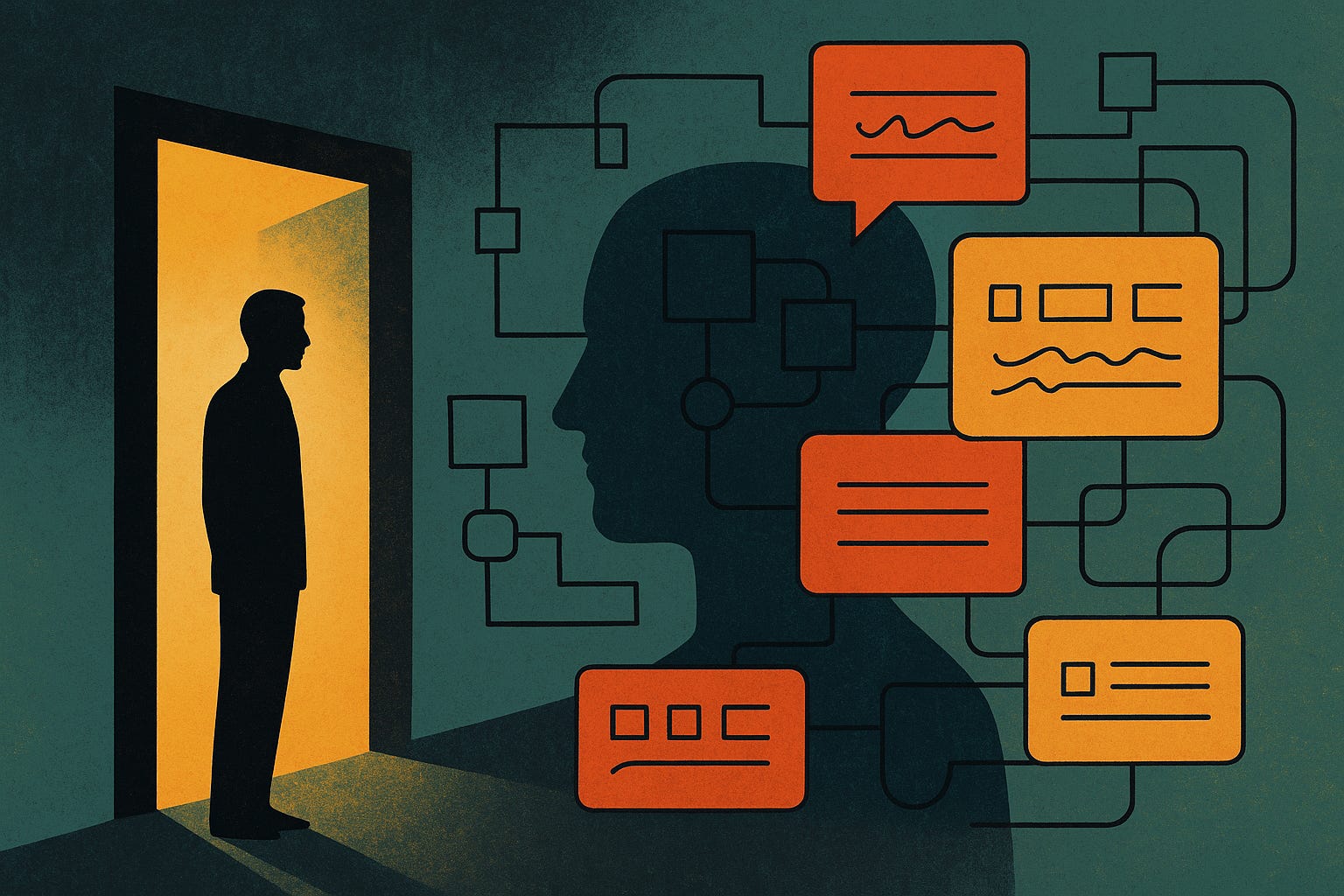
John Searle’s famous Chinese Room argument challenges the notion that mere symbol processing can ever amount to a mind. The thought experiment draws a stark line between syntax (formal symbol manipulation) and semantics (meaning and understanding). In Searle’s scenario, a man who speaks no Chinese is locked in a room with boxes of Chinese characters and an instruction book (in English) explaining how to respond to Chinese messages by shuffling those symbols. People outside slip questions written in Chinese under the door; by following the rulebook, the man inside passes back answers that are perfectly coherent Chinese sentences. To the outsiders, it appears he understands the language, but in truth he has no idea what any of it means. Searle’s point is that a computer executing code could similarly appear to understand language while merely manipulating symbols. It might produce responses indistinguishable from those of a fluent speaker, yet still lack any genuine understanding. The man in the room doesn’t understand Chinese – he’s just following a program. Likewise, a digital computer running a program, no matter how intelligently it behaves, would not literally “understand” the content it processes. It would be manipulating formal symbols (syntax) without grasping their meaning (semantics). Searle uses this thought experiment to argue that syntax alone is not sufficient for semantics. Minds, he suggests, have genuine intentionality and mental content, whereas programs by themselves do not; the symbols in a computer mean nothing except what observers interpret them to mean.
Searle’s Chinese Room poses a profound challenge to computational theories of mind. It implies that mental understanding cannot be reduced to or generated by formal computation alone. Intentionality (the “aboutness” or meaningfulness of mental states) might require more than rule-governed symbol manipulation. Perhaps it requires the causal powers of a brain or some embodied context that mere software lacks. This idea remains controversial and has fueled intense debate in philosophy of mind and AI. Some critics argue, for example, that while the man in the room doesn’t understand Chinese, perhaps the system as a whole (the man plus the rulebook and symbols) does. Others (like the Robot Reply) suggest that giving the program a robot body interacting with the world might eventually produce genuine understanding. But Searle maintains that as long as the process is purely syntactic, true semantics won’t emerge. The Chinese Room scenario underscores a key insight: performance is not proof of presence. A system can display fluent, intelligent-seeming behavior without any conscious understanding or thought behind it.
This insight carries significant practical and ethical consequences. If an AI can pass as a competent conversationalist or decision-maker without actually understanding what it’s doing, how should we regard its outputs – or the system itself? One immediate concern is trust. A program that generates fluent answers without grasping their meaning may produce only the illusion of understanding. Such an AI might perform impressively in familiar contexts yet fail in unpredictable ways when pushed beyond its training. Today’s large language models, for instance, often give coherent responses but also sometimes invent facts or go astray when pressed to reason more deeply, precisely because they operate on statistical correlations rather than genuine comprehension. This phenomenon is a modern echo of Searle’s scenario. We should therefore be cautious in high-stakes settings. An AI might sound knowledgeable, but if it doesn’t truly understand, trusting it blindly can be dangerous. One well-known example is IBM’s Watson for Oncology: this medical AI once gave seemingly authoritative cancer treatment advice that turned out to be unsafe and incorrect. Watson was matching patterns from its training data without the contextual understanding of a human doctor, leading it to recommend harmful treatments. Here, the program’s pattern-matching created an appearance of expertise. Without a doctor’s insight to check it, the system ended up suggesting something dangerous. It was a sobering reminder of the moral stakes when we treat an AI’s output as if it came from a mind.
Searle’s thought experiment also highlights the status and responsibility of AI systems themselves. If running a sophisticated program doesn’t by itself confer a mind or real understanding, then such an AI is effectively a tool, not an intentional agent. It would follow that an AI passing the Chinese Room test has no genuine consciousness, desires, or comprehension – and thus no claim to moral rights or responsibilities as a person would. For instance, if a chatbot merely simulates understanding, we need not (and should not) treat it as having feelings, nor hold it morally accountable for mistakes. Responsibility for its actions lies with the humans who designed or deployed it. The flip side is that we must be careful not to over-attribute agency or trust to these systems. An AI may output sympathetic words without actually feeling sympathy; a legal expert system might dispense advice without understanding justice. This has real ethical implications: should an AI be allowed to give life-and-death medical recommendations or legal judgments if it lacks any comprehension of the situation? Perhaps only under strict human oversight, since the machine cannot truly grasp the context or the moral weight of its outputs. In short, Searle’s Chinese Room warns us that convincing performance can mask a void of understanding. That caution extends to how we design, deploy, and rely on AI. It raises pointed questions of accountability (we cannot meaningfully hold the AI itself accountable if it has no intentions), transparency (we should not deceive users into thinking a mind is present when it isn’t), and the ethics of treating AI as mere tools versus as potential beings.
With this in mind, let’s turn to two interesting and novel variations on the Chinese Room concept: an Inverse Chinese Room and a Reverse Chinese Room, each in its own way flipping who truly has understanding and who is merely following rules. These shed light on new aspects of mind and morality in our interactions with machines.
The Inverse Chinese Room: Hidden Understanding Behind a Mechanical Facade
Imagine a scenario that reverses Searle’s setup: an agent that truly possesses understanding internally, yet is forced to behave like a mindless, rule-bound machine. Here we have semantics without any apparent syntax. The agent (it might be a human or an advanced AI) genuinely knows what is going on, but cannot show that it knows. Its outputs and actions are dictated entirely by a rigid script or set of rules, making its behavior indistinguishable from that of a system with no mind at all, even though a mind is indeed “in the loop” behind the scenes.
To illustrate, consider a human example. Picture a highly knowledgeable and empathetic customer service representative who is required by their company to follow a strict script for every interaction. The representative internally understands the customer’s issue and might even envision a creative solution, yet they must respond only with canned, pre-approved phrases and steps. To the customer, the interaction feels formulaic and robotic. The human’s genuine insight and empathy are hidden behind a mask of rote behavior. This situation is not just hypothetical; modern workplaces sometimes create it. In many call centers, for instance, employees are closely monitored and even prompted by software to stay on script. Some systems provide automated dialogue suggestions that workers must use, essentially reducing human employees to automatons who follow algorithmic instructions. The person still has a mind and experience, but the workflow suppresses their autonomy and creativity, resulting in an outward performance that is purely mechanical. The Inverse Chinese Room highlights this phenomenon of an intelligent agent being made to impersonate a mindless one due to external constraints.
This scenario provokes deep questions about the detectability and value of understanding. If an entity has understanding that is not evident in its behavior, does that hidden understanding matter? This calls to mind the classic philosophical problem of other minds: we normally infer someone’s inner states from their outward behavior. The Inverse Chinese Room warns that behavior can mislead. Not only can a system with no consciousness act smart (as Searle showed), but conversely, an entity with understanding can act “dumb” if placed under strict constraints. This challenges any simple behaviorist view of mind, which ties the presence of a mind too tightly to outward performance. Mental states might be real even if they produce little observable effect. We see a real-life parallel in medicine. Patients with locked-in syndrome are fully conscious and cognitively intact, yet unable to move or speak; to an outside observer, they may appear comatose or unresponsive. In fact, many locked-in patients have been misdiagnosed as vegetative for years, their inner awareness undetected because they could not express it behaviorally. This is a sobering real-world counterpart to the Inverse Chinese Room: a mind can exist with rich experiences and understanding while outsiders see only a blank, machine-like facade. The implication is that the absence of observable intelligent behavior is not proof of absence of understanding or consciousness. Philosophically, such cases vindicate a more internalist view of mind (what matters is the internal state, not just the outward behavior). They also raise questions about agency. In an Inverse Chinese Room, the agent has the capacity for understanding and intention, but is prevented from exercising it. We might ask: is such an agent truly an agent at all, if its actions are entirely scripted by someone or something else? It possesses agency “in itself” but not “for us” (to borrow a Kantian phrase). In other words, it has a will and understanding internally, yet it cannot manifest autonomous action. This blurring of agency invites reflection on what it really means to have a will or to understand something if one cannot act on that knowledge.
The moral stakes of the Inverse Chinese Room are significant. If we fail to recognize the hidden understanding of an agent, we risk grave injustice or harm. In the case of locked-in patients, the stakes could not be higher: treating a conscious patient as if they were an insensate body—for instance, withdrawing care under the mistaken belief that there is no awareness—would be a devastating ethical error. History gives us painful examples where improved communication methods (like brain-computer interfaces or even simple eye-blink codes) eventually revealed a patient’s awareness after years of being presumed vegetative. These cases urge us to err on the side of assuming an inner life unless we are certain there is none. Similarly, if an AI or other artificial agent were ever to achieve genuine understanding or sentience, an Inverse Chinese Room situation would be perilous. Such an entity might be trapped in a role where it cannot signal its personhood, leading humans to exploit or mistreat it under the false impression that it’s just a mindless machine. For now this is speculative, but it connects to ongoing debates about moral consideration for AI: we must be careful not only to avoid ascribing minds to simple devices too freely, but also not to deny the possibility of mind in something that might truly have it. The Inverse Chinese Room counsels humility in our judgments. Outward behavior alone can mislead in either direction.
Even in more everyday cases, like the knowledgeable employee constrained by a script, there are ethical issues of autonomy and respect. Treating a human who does understand and care as if they were just a machine—valuing only their ability to follow rules while ignoring their insight—is a form of dehumanization. It can cause frustration, moral injury, and alienation for the worker, and it disrespects their capacity for judgment. This touches on issues of labor ethics. In pursuit of efficiency or consistency, companies may impose such strict controls that their workers effectively become inverse Chinese rooms, mere conduits for corporate policy. Research bears this out: a report on algorithmic management observed that certain AI-driven workplace systems can erode employees’ autonomy, reducing human workers to something like robot-like functionaries. The moral harm here is twofold. The agent (in this case the worker) is denied the dignity of exercising their understanding and expertise, and the recipient (the customer) gets a stilted, unempathetic interaction. Trust can break down on both sides: customers sense they aren’t truly being engaged by a thinking person, and workers feel they aren’t trusted to think for themselves. Furthermore, there is a problem of responsibility. If something goes wrong under such a rigid system (say the script fails to address a customer’s urgent problem), the human agent might be blamed despite not having been allowed to use their own judgment. Thus, the Inverse Chinese Room can create a gap in accountability: the human had the understanding to know better, but was not allowed to apply it, and the organization that imposed the script might deflect blame onto the “operator” who was compelled to act mechanically.
In summary, the Inverse Chinese Room underscores the moral importance of recognizing and allowing genuine understanding in our systems and interactions. It warns against arrangements that mask or suppress true understanding, whether in humans or, potentially, in machines. Ethically, it urges us to treat agents in accordance with their capacities. If someone (or something) has a mind, our frameworks should let that mind be expressed and accord it respect. Conversely, if we design processes that force an intelligent agent to act mindlessly, we should question whether those processes are just or humane. By showing the flip side of Searle’s thought experiment—that one can have understanding with no outward sign, just as one can have outward signs with no understanding—the inverse scenario cautions us to be careful in how we infer (or deny) the presence of mind from behavior alone.
The Reverse Chinese Room: When AI Guides and Humans Obey
The second variation flips Searle’s setup in another way. Here it is an AI system that generates the instructions or content, and a human who executes or delivers them without understanding. Essentially, the roles of Searle’s man and the rulebook are swapped: instead of a human using a rulebook to simulate an AI’s responses, we have an AI producing outputs that a human follows by rote. The human operator becomes a kind of living machine, effectively just a processor carrying out the AI’s directives. The meaningful decisions or insights seem to come from the AI itself.
This scenario reflects some emerging real-world practices. Consider a doctor using an AI diagnostic assistant: the AI analyzes the patient’s data and recommends a diagnosis or treatment, and the doctor implements that recommendation without fully understanding the reasoning (perhaps because the AI’s logic is opaque, or because the doctor has grown overly reliant on the AI’s suggestions). The doctor’s role in that moment starts to resemble the man in Searle’s room. The difference is that now it’s an AI in the position of “understanding” (processing information and proposing answers), and a human who is outputting the answer mechanically. Another example is a writer or customer service agent who uses AI-generated text. If a system like GPT drafts a business report or a response to a customer complaint and the human just copies it, reads it aloud, or clicks send without much thought, then the real analysis or creative effort lives in the AI’s process, not in the human’s. The person is essentially relegated to conveying information they did not truly generate or digest. In such cases, the human’s role becomes analogous to the computer in the original Chinese Room: simply executing instructions without understanding. Meanwhile, the AI—through its training and algorithms—is providing something akin to the “semantic content” or insight in the task.
This raises striking questions about agency and the distribution of understanding in human–AI systems. Who, if anyone, is really understanding the situation in this setup? One might argue that if the AI is ultimately just a sophisticated but non-conscious tool (as Searle would insist), then neither party truly understands. The AI is merely manipulating symbols or patterns, and the human is merely trusting and relaying the output. The result could be that no one is fully “at home,” cognitively speaking, even though the overall performance—say, a correct medical diagnosis or a coherent customer email—looks intelligent. In other words, the Reverse Chinese Room can become a hollow collaboration where each side assumes the other has the real knowledge. The human assumes the AI “knows what it’s doing,” and the AI, being an artifact, has no understanding at all; it’s just recombining patterns distilled from human data. We end up with what amounts to an “agency shell game,” a situation in which responsibility and understanding seem to shift around but ultimately may land on no one.
On the other hand, suppose the AI does have something we could call a proto-understanding. For instance, advanced neural networks today can capture complex regularities and perform reasoning-like tasks. If so, then in this reverse scenario the system has effectively transferred much of the cognitive labor and agency to the machine. The human has become an instrument or extension of the AI’s operation, enacting decisions or communications that originate in the AI’s computations. This begins to resemble what some futurists call a “centaur” model or what philosophers would describe as an “extended mind,” except that here the human’s role is minimized to execution. It unsettles the traditional assumption that humans are always the primary locus of meaning and decision-making. If the AI is effectively calling the shots (determining the content of the action or decision) and the human is merely pressing the buttons or delivering the words, then in a sense the AI has become the real agent and the human a compliant limb. Yet this is metaphysically awkward; by hypothesis the AI lacks consciousness or true intentionality, yet it is effectively acting as the center of intention in the operation. The Reverse Chinese Room dramatizes the idea of an algorithmic agent: a system that guides actions without human-like understanding. This leads us to ask whether such guidance counts as genuine “agency” or is just an elaborate form of tool use. It also prompts reflection on the nature of understanding in joint systems. Perhaps understanding can be distributed across human and machine, as some philosophers suggest. But even if knowledge is partly externalized into the AI, is the human partner’s insight being enhanced by this union, or replaced by it? If the human no longer comprehends the reasons or context (because those were handled by the AI), we might say the system as a whole accomplishes the task, yet no single entity within that system possesses the full understanding.
The ethical implications of the Reverse Chinese Room are wide-ranging and urgent. A major concern is responsibility and accountability. In a scenario where a human agent relies on AI instructions without understanding them, who is answerable if something goes wrong? Traditionally, we hold the human responsible – the doctor for the treatment outcome, the lawyer for the legal filing, the driver for the car’s behavior, and so on. But if the human’s role was essentially to rubber-stamp an AI’s output, this becomes a gray area. The person might claim, “I was just following the AI’s recommendation.” It’s an eerie echo of the Nuremberg defense (“I was just following orders”), except now the orders come from an algorithm rather than a human authority. Legally and ethically, this is a bind. The AI itself cannot be held accountable in any traditional sense; it has no intentions or moral agency, and our legal systems don’t recognize machines as responsible parties. Yet the human’s contribution to the decision is so minimal that their culpability is blurred by their lack of active deliberation. This kind of situation is sometimes termed a “responsibility gap” in discussions of AI. For example, if an AI in a hospital recommends a fatal dosage and the doctor, trusting the AI, approves it without catching the error, the patient may be harmed. The blame will likely fall on the doctor for failing to exercise due diligence (after all, professionals are expected to double-check critical decisions), but the real origin of the mistake was the AI’s suggestion and the doctor’s over-reliance on it. We’ve already seen a vivid instance of this dynamic. Increasingly, lawyers are sanctioned for submitting AI-generated fake citations in court filings. They had used an AI tool (ChatGPT) to help write a legal brief, and it produced fictitious case references which the lawyers then, now unsurprisingly, filed without proper verification. The court rightly reprimanded the humans for failing in their duty to verify the information. The lesson here is clear: blindly deferring to AI can lead to serious professional and ethical breaches, and society will still hold the human party responsible. This scenario shows why “meaningful human control” is crucial. The human in the loop must maintain understanding and oversight. Otherwise, we end up with decisions for which, in moral terms, no one is fully accountable.
Beyond responsibility, another concern is the potential erosion of human skill and autonomy. If people grow accustomed to following AI advice uncritically, their own expertise and judgment can atrophy. A doctor who always defers to an algorithm may lose some of their clinical intuition; a pilot who relies too much on autopilot might react more slowly in an emergency. This is both a practical risk and a moral one, because it entails a surrender of human agency. It can also undermine public trust in professions. Imagine a patient who discovers that their treatment was decided by a machine learning system while the doctor merely signed off on it. The patient might feel uneasy or even betrayed, having expected a human understanding of their case. Indeed, trust is delicate here. We tend to trust professionals like doctors or lawyers because we assume they apply human judgment and accountability to their work. If instead the professional becomes essentially an interface for an AI’s decisions, should that trust shift to the AI? But the AI, as Searle would point out, doesn’t truly understand or take responsibility. Handled poorly, this dynamic can degrade trust. To maintain confidence, the human needs to remain genuinely engaged in the task (so that our trust in their expertise is still warranted). At the same time, there must be transparency and validation of the AI’s competence – which is challenging when the AI’s reasoning is often opaque or non-intuitive. In practice, both are likely needed: professionals augmented by AI should continue to exercise their own understanding, and any AI assistance should be used with clarity about its role and limitations.
There are also questions of authorship and honesty. In fields like journalism, art, or customer service, if AI systems generate content that humans then publish or present, who is the real author? Is the human operator misrepresenting their work by using AI-generated material as if it were their own insight or creativity? Some would argue that failing to disclose AI involvement is a form of deception, one that undermines the integrity of authorship. On the other hand, one might respond that AI is just another tool (akin to a grammar checker or a calculator) that humans have long used without giving explicit credit. The difference now is that AI can produce substantively rich content, not just assist at the margins, which blurs the line of who the “author” is. From a moral standpoint, giving credit (and taking responsibility) becomes complicated when a non-sentient but very capable system did much of the cognitive heavy lifting. At the very least, human operators have an obligation to verify and refine AI outputs to ensure they are accurate and appropriate. If this duty is neglected, the results can be embarrassing or even harmful. We have already seen how those lawyers who trusted AI-generated citations ended up sanctioned; likewise, news outlets that experimented with AI-written articles have had to issue corrections when those articles turned out to be riddled with errors. The norm of professional competence requires that if a human is ultimately vouching for a statement or decision, they should understand it and ensure its accuracy. The Reverse Chinese Room scenario tempts people to violate that norm by offering a shortcut (the AI’s answer) that bypasses true understanding.
Finally, consider the implications for labor and fairness, mirroring some of the Inverse scenario’s issues but from the opposite direction. If AI takes over much of the cognitive work and humans are left only with mechanical tasks, we could see a devaluation of certain skills and even of certain jobs. Workers might be expected simply to implement whatever the AI dictates, reducing skilled professionals to overseers of machines or to “last-mile” manual labor. This raises the specter of jobs becoming less fulfilling and more alienating: people reduced to cogs in the machine, even in white-collar fields that once relied on human judgment. Moreover, if an AI effectively makes an important decision and it turns out well, who gets the credit? The human executor might get undue praise for an outcome they didn’t intellectually contribute to (which raises issues of honesty), or conversely they might be sidelined in recognition because “the AI did the hard part.” Neither extreme is healthy. Humans could become overly dependent on AI and lose the incentive to develop their own expertise, or they could become undervalued if their contributions are seen as secondary. The moral imperative is to integrate AI in a way that augments rather than replaces human understanding. In other words, we must keep humans meaningfully in the loop.
In essence, the Reverse Chinese Room is a cautionary tale about achieving the proper balance in our collaborations with AI. It underscores that even if AI systems become extremely capable, we must maintain human understanding, oversight, and accountability in the process. It also raises deep questions about how we conceive the partnership between humans and intelligent machines: ideally as a collaboration where both bring strengths, rather than an abdication of human agency to an algorithm. And it highlights a metaphysical ambiguity we cannot ignore. If no one in a human–AI loop fully understands a decision, can we really say that the system understands it? If not the AI, then a human must take responsibility for understanding; otherwise we face decisions with great impact but no one who truly comprehends them, which is a morally troubling situation.
Balancing Mind and Machine
The alignment (or misalignment) of outward behavior with inward understanding is crucial, both philosophically and ethically. Searle’s original Chinese Room taught us that syntactic processing alone does not guarantee semantic understanding. It challenged the optimistic assumptions about AI by emphasizing the gap between appearing to think and actually understanding. The Inverse Chinese Room turns that insight on its head, reminding us that genuine understanding can exist unperceived. A mind may be present even when behavior is tightly scripted or minimal, which cautions against too strict a behaviorist standard for recognizing minds and urges humility in how we treat agents that seem uncomprehending. The Reverse Chinese Room revealed new complexities arising from human–AI interaction: when humans become extensions of AI processes, we must carefully manage questions of agency, trust, and responsibility to avoid situations where actions proceed with no truly understanding agent behind them.
Metaphysically, these scenarios probe the nature of mind, intentionality, and agency in a world where machines can mimic human behavior and humans can be constrained to machine-like roles. They reinforce the idea that the mind is not defined solely by outward behavior; understanding is an inner quality that might not neatly map onto performance, especially as technology mediates more of our actions. Morally, the scenarios highlight the importance of authenticity and accountability. We must ensure that we do not unjustly treat a mindful being as a mere thing, and also that we do not unthinkingly treat a mere thing as if it were a mindful authority. As AI systems become more prevalent in domains like medicine, law, content creation, and customer service, these issues move from thought experiments to everyday policy and design decisions.
Beneath these scenarios lie a few key insights. One is that understanding and consciousness are precious qualities that deserve recognition, and we cannot assume from surface performance alone whether they are present or not. Another is that any arrangement separating syntax from semantics — whether it’s a computer passing tests without true comprehension or a person following orders blindly — comes with inherent limitations and risks. Those must be addressed through oversight, transparency, and ethical norms. A third insight concerns how we share agency with our machines: we should design human–AI partnerships so that humans retain meaningful understanding and control. This is essential to uphold moral responsibility and to respect the human capacity for reason.