
The Coevolution Lens
What can AI do to us?

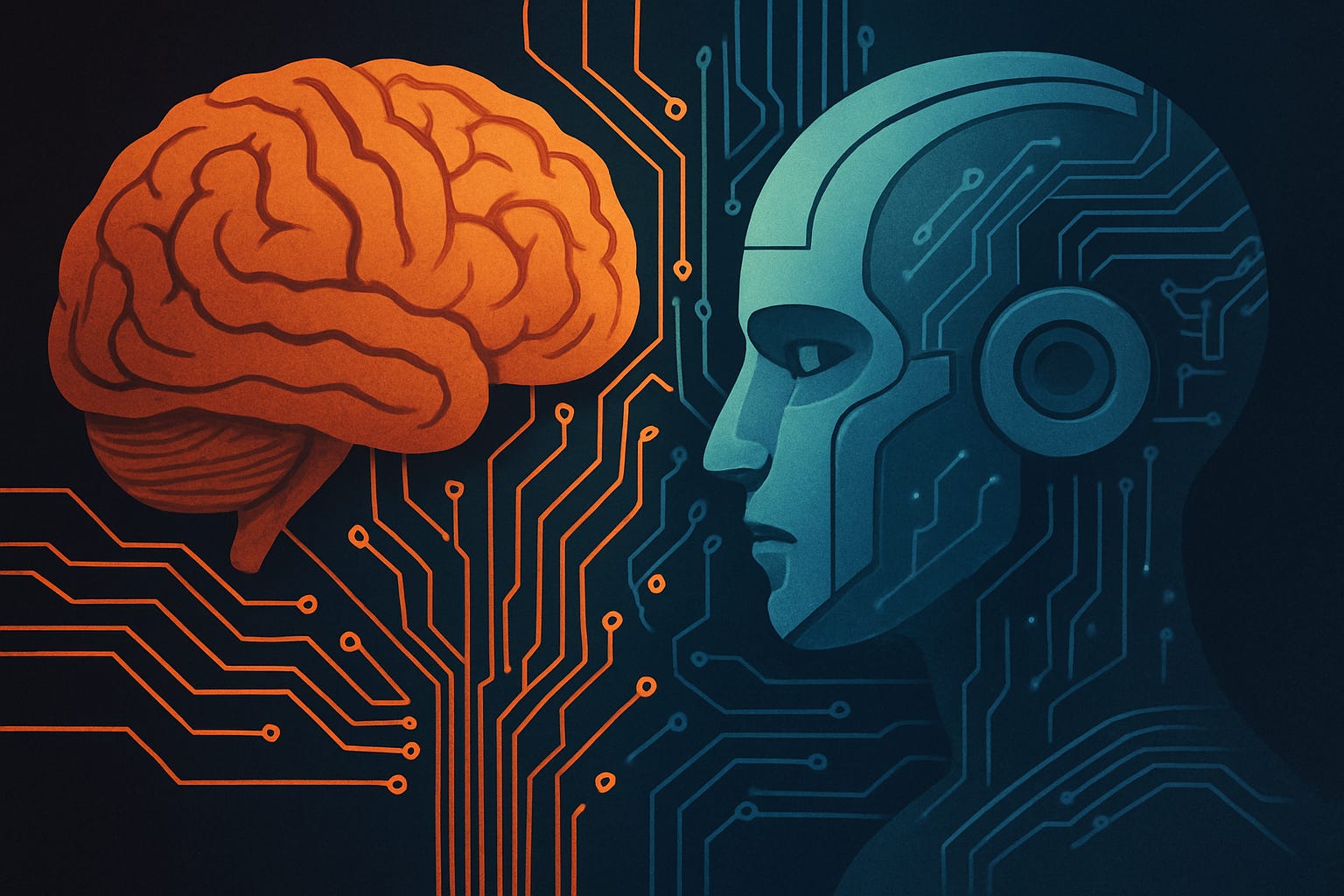
The prevailing question of the moment is “What can we do with AI?” The more urgent question, and the one I am increasingly interested in, is “What can AI do to us?” The second question tends to unsettle people. It flips the usual framing and forces us to consider that AI may already be reorganizing the ground we stand on. We build these systems, yes, but we also absorb their influence. They adjust how we work, what we notice, how fast we move, and what we think counts as a competent thought. That influence is not subtle. It is the largest shift in the cognitive and institutional environment since the spread of digital networks.
The idea of humans and AI “coevolving” is only a metaphor, but a useful one. It makes clear that this relationship has feedback, momentum, and consequences that build year after year. We shape the machines; the machines, in turn, shape the conditions under which we act. Ray Kurzweil has spent decades describing this dynamic in terms of acceleration. His claim is not simply that new tools amplify human capability, but that amplification produces new expectations for what humans should be able to do. Once calculators became cheap and ubiquitous, people adjusted their idea of “basic” mathematical fluency. Once search engines took over recall, our relationship to memory changed. AI pushes this further. It changes not only what we remember or how we calculate, but how we reason. It offers conclusions before we trace the path. It completes thoughts before we finish forming them. In such an environment, human cognition begins to reorganize itself by necessity. One cannot continue to think in the same way when the marginal cost of generating a plan, a paragraph, or an entire argument drops near zero.
Thomas Kuhn would recognize what is happening, though he wrote long before machine learning. His view was that scientific revolutions occur when the old framework for interpreting evidence stops working. Something similar is happening now. AI does not simply accelerate existing patterns of inquiry; it quietly rearranges them. If a system retrieves, structures, or summarizes information for you, it is also nudging your sense of what material matters. Over time, the pattern becomes familiar and then invisible. What once felt like a machine’s stylistic quirk becomes the background noise of modern reasoning. This is a subtle kind of paradigm shift, one that happens not with a dramatic break but through cumulative adoption. The more we depend on AI for early steps in thinking, the more we accept its framing of the problem before we realize a framing has been imposed.
Other writers saw the psychological and philosophical side of this long before GPT models entered the scene. Andy Clark described humans as creatures who naturally extend their minds into tools. It is not a metaphor when he says that notebooks, diagrams, and devices become part of the cognitive loop. With AI, the loop tightens, because the tool pushes back. It suggests. It anticipates. It asks questions. People begin to treat these behaviors as part of their own thought process. Bernard Stiegler placed emphasis on the double character of technology, which both empowers and erodes. He liked the old Greek idea of the pharmakon, a substance that is both poison and remedy. What matters is not whether the substance is dangerous but whether the society using it understands its danger and manages it well. N. Katherine Hayles pressed even further. She argued that once cognition flows across a network of humans and machines, the boundary of the self shifts whether one wants it to or not. Agency becomes something negotiated rather than isolated.
These perspectives point toward a simple observation. Our institutions will not remain unchanged by AI. They will reorganize themselves around whatever lets them move faster, plan better, or protect themselves from uncertainty. A government office that adopts strong AI-based forecasting will outpace one that clings to the old model of static reports. Similarly, a laboratory that uses AI to generate hypotheses will produce results that marginalize those who labor through traditional literature reviews. This creates pressure on individuals as well. People who learn to work with AI gain an advantage in the labor market. People who do not risk being seen as slow or incomplete. These are not theoretical shifts. They are already visible across multiple fields. The environment is selecting for new forms of cognition that fit comfortably beside or above automated systems. The result is a kind of social evolution, guided less by biology and more by institutional survival.
The changes already underway fall into a few broad movements, though they are not clean categories. Human cognition drifts. When a machine handles the first draft of a plan or a summary or a research path, people shift their attention to oversight rather than construction. That may free time for judgment, or it may weaken the skill of building ideas step by step. Behavior shifts as well. What people see, believe, or prioritize is shaped by systems that decide which options surface first. Even small nudges accumulate. Over years, those nudges become a structure for preference and perception. And institutions accelerate. Once a large organization commits itself to AI-assisted decision making, others in the same domain feel compelled to follow or risk sliding into irrelevance. These forces move together, each reinforcing the others.
The important part is not to wring hands about it but to admit that the relationship between humans and AI will shape both sides. The influence will not stay neutral. If AI becomes a collaborator in cognitive life, then the design of AI becomes a design of the future human landscape. We should be honest about what qualities we want preserved. Judgment matters. Ethical reasoning matters. The ability to hold competing interpretations in mind matters. None of these should be surrendered simply because a system can produce an answer faster than a person can think it through. The aim should be to use AI to support human judgment, not to hollow it out.
The coevolution metaphor reminds us that we still have agency. AI is not a natural disaster. It is a set of systems we build and refine and deploy. The question is whether we intend those systems to expand human freedom and capability or whether we let them narrow the range of acceptable habits and thoughts. Humans have changed alongside their tools for centuries, but never at this pace and never with tools that react and adapt to us in return. That level of responsiveness can strengthen us or make us dependent. It can broaden our sense of the world or compress it. Which outcome we get depends on how seriously we take our responsibility as designers, policymakers, and users.
AI will change us whether we participate in shaping that change or not. The only real choice is whether the influence leads toward a society with stronger judgment, deeper capability, and more room for human character, or toward one that sleepwalks through a transformation it did not choose. The moment demands clarity. AI is not only something we use. It is something that uses the conditions of our world to press us into new shapes. If we want to remain authors of our own story, we must meet that pressure with intention, not complacency.