
The Hesitation
World Cup Mania!

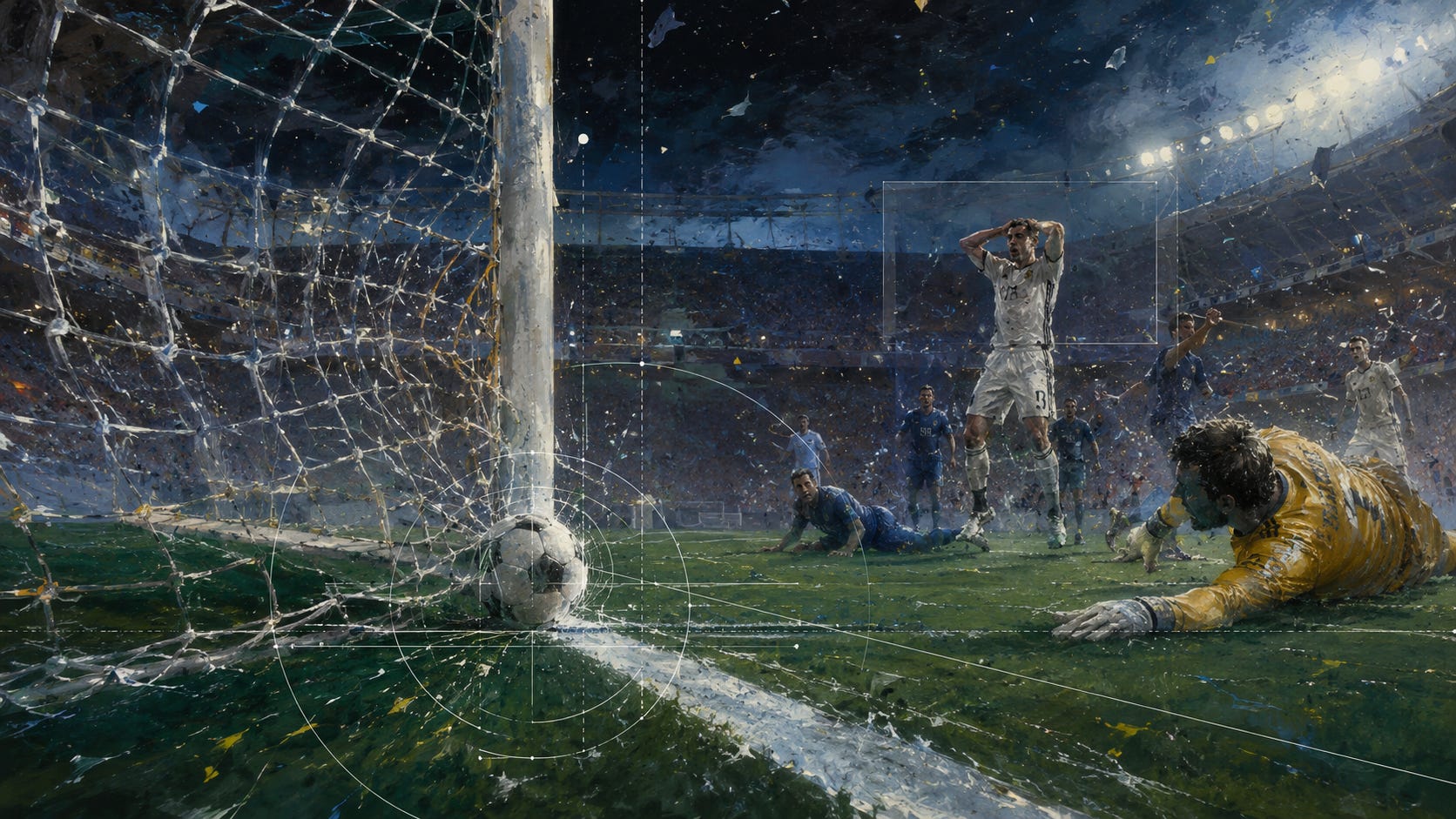
Soccer has a new gesture, and you can watch it this month in any stadium in North America. The ball crosses the line, the net ripples, and eighty thousand people begin to rise. Then they stop.
Arms half-raised, eyes off the field and up to the screen. The players do it too. The scorer starts to run and then pulls up, glancing back at the referee, waiting to learn whether the thing that just happened has happened. Somewhere in a windowless room, officials are drawing lines on a frozen frame.
The crowd holds its joy in escrow. Sometimes the check clears and there is a second celebration, smaller and stranger than the first would have been, the spontaneity already spent down. Sometimes the goal is unmade and eighty thousand people put their joy away half used, trying to force the shaving cream back into the can, somehow.
Fans, we know the posture now. You cheer at half-volume. You keep something in reserve. Players score and make a gesture that did not exist ten years ago, palms pressed down toward the grass, wait, wait. Both the literal and metaphorical opposite of both hands to the heavens, raising the roof. The most powerful collective emotion in sport, the eruption after a goal, now comes with a condition attached. Joy waits for a ruling.
It is worth being clear about what has changed here, because the rules of soccer have not “changed” per se. A goal is still a goal. Offside is still offside. What changed is when we are allowed to know.
For most of the game’s history, the goal became real the instant the referee pointed to the center circle. Everyone got the news at once. The referee was sometimes wrong. Sometimes he was horribly wrong, wrong in ways that decided championships and broke nations’ hearts. But the wrongness became part of the event, because there was no way to reopen it. The moment was final because finality was the only technology available.
Video review ended that. Now every important moment is conditionally true. The present tense has been demoted to a draft.
Once you see the structure, you start seeing it everywhere. You watch something happen with your own eyes and wait for the fact-check. You read the news and wait for the correction. You see the clip and wait for the longer clip, the context, the note underneath explaining what you missed. The hesitation in the stands is the body learning a new joga bonito: do not trust the moment until something above the moment approves it.
Video review was not imposed on soccer by engineers. It was demanded, for decades, by the people who watch and play, who had decided that the wrong call was intolerable. Every review system we have built, in sport and outside it, comes from the same refusal. We looked at injustice and declined to absorb it. That refusal is not a flaw. It is one of the most defensible instincts a civilization has. The whole structure of appeal and audit and oversight rests on it.
I should say where I stand, because I have spent some time in the correction business. Finding the wrong calls and insisting they not stand. I believed in that work and still do. If you have watched what an unreviewed system does over time, watched money move on diagnoses no doctor wrote, you do not come away thinking that letting it stand is wisdom. So this is not a complaint about review itself. The review instinct built the appeals court, the audit trail, most of what makes a large institutions survivable.
But it carries a price we seem to have now agreed to pay without naming and that price is the present. What we actually see happening here is the breaking of a distinction. Done right, oversight looks forward. You study the missed handball not to unmake the goal but to understand why the referee could not see it and to change what happens the next ten thousand times. What we built instead runs backward. It holds every moment open in case we want to reopen it. These are two different kinds of work. One says wrongs will happen, absorb this one, and let us make the system that produced it better. The other says no wrong shall stand, ever, and we will stop the world as long as it takes. The first builds institutions. The second dissolves the present.
Look at what the old game actually asked of people. The referee missed the handball, the goal stood, and the institution’s whole answer to your fury was: yes, and play continues. That sounds like a failure, and the reform movement treated it as one. But it was practice. Eighty thousand strangers absorbing an injustice in real time, raging at it, and then turning back to the field, because there was nothing else to do. The wronged team had to keep playing immediately, with the wound still open. It rehearsed, every week, in public, the hardest and least teachable skill there is, which is continuing after a call that will never be reversed.
And the wrongs that stood did something corrected wrongs rarely do. They became part of the shared world. Maradona’s hand has been argued about for forty years. It produced books, documentaries, jokes, grudges, theology. He named it himself, the Hand of God, and the name held because the act was permanent. That does not make the injustice good. It means the injustice became usable. People could fight over it, remember it, inherit it, and eventually make some kind of peace with it. Now run it again with video review in 1986. The goal is checked and waved off in ninety seconds. Justice is done and nothing is left. No Hand of God, no forty years of argument. A line on a screen, a restart, a footnote. In all likelihood, I’m not talking about Maradona in the same rapt tone. The corrected wrong is accurate but also gone.
Here is the part that should concern us most. The machine does not even give us what it promised. The deal, as sold, was that we would trade the eruption for the truth. We gave up the eruption and the truth never came. The offside lines are drawn at margins no eye can see, on frames no human chose, read by officials in a room and argued about in the press conference anyway. The fights did not end. They moved up a level, from what happened to whether the instrument was right. The goal was never just a fact waiting for a machine to find it. It was a decision everyone agreed to live inside, made all at once, and lived with. Video review did not find a truth underneath the decision. It showed that the decision was all there ever was and then it took the decision away from the present.
So what we lost is not accuracy, which we never had. What we lost is commitment. The old wrong call was at least a fact you could live inside. It was shared and final and therefore usable, something you could build forty years of argument on, and that argument was a kind of relationship. The reviewed call belongs to no one. It is correct, maybe, and inert. A person who cannot commit to the present, who treats every wound as a case that might still be reopened, is living in a kind of standing appeal, which is not quite living.
Because most of the injustice in a life is the kind that stands. This is what the whole machine exists to help us avoid saying. The diagnosis that came too late. The parent who never apologized. The years given to an institution that did not give them back. The person who left and was wrong to leave and will never be ruled against by anyone. There is no booth for these. No one is drawing lines on a frozen frame of your life and the review you run at three in the morning reports to no one, moves no needle. The bad call that stands is the normal condition of being a person. The game knew this and made us practice. We watched the wrong goal count, we screamed, and then the ball went back to the center spot and play resumed, and we learned, eighty thousand at a time, that continuing is possible.
The tournament this month will be the most reviewed in history. I will watch it anyway, and at some point a ball will cross a line and I will catch myself rising with my arms half up, eyes already going to the screen, waiting for permission. The hesitation is in my body too. I do not expect to lose it. But I want to know what it is: the posture of people who decided that no wrong should ever stand, and found out too late that a world where nothing is allowed to stand is a world where nothing holds. The whistle blows. The goal counts or it does not. The ball goes back to the center spot. Then, somehow, play resumes.