
The Portrait We Paint
On America, Tocqueville, and the attic at the top of the stairs

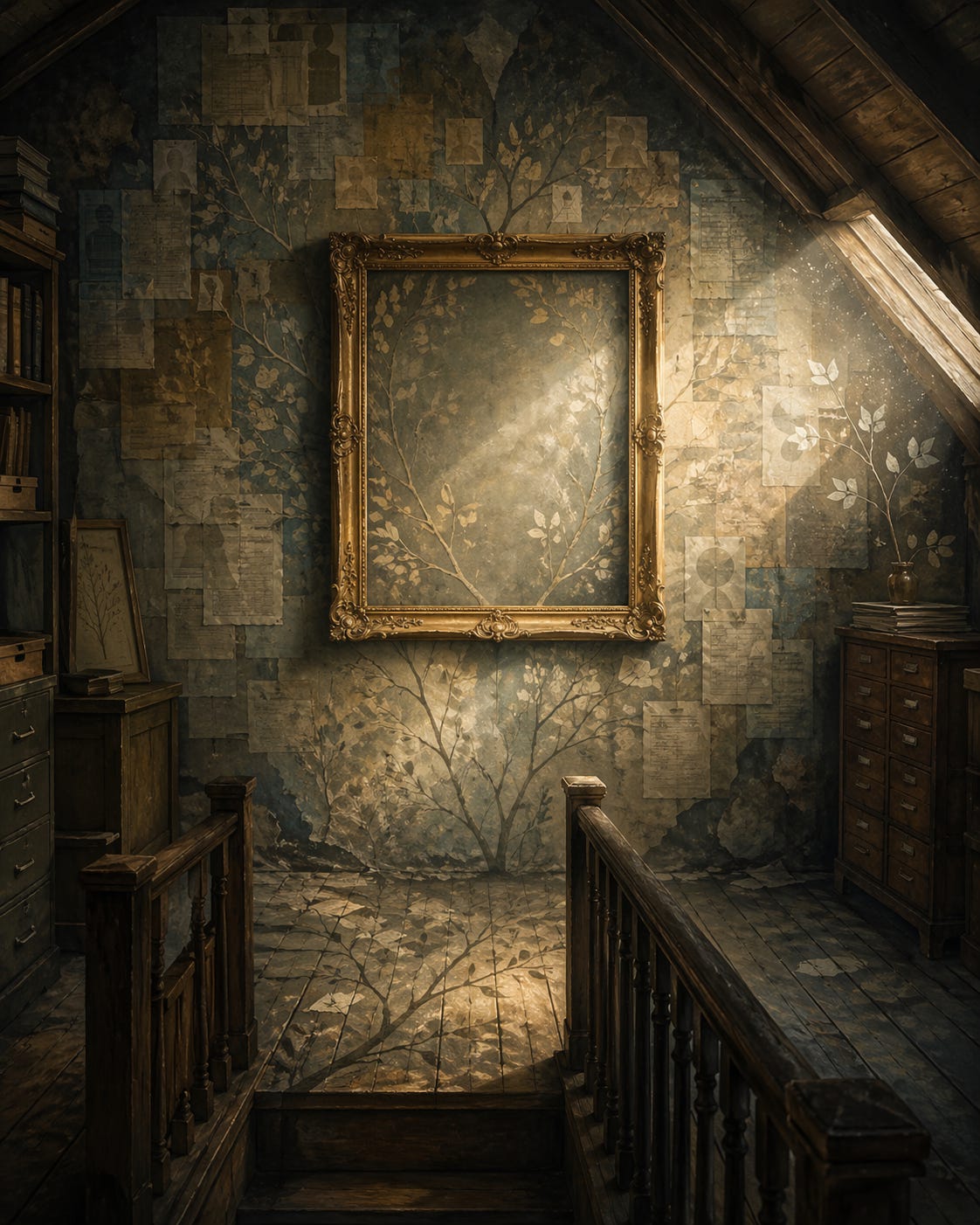
Dorian Gray climbs the stairs. He unlocks the room. He looks at the painting. He locks the room behind him and comes back down, and the face he shows the world remains the face he was born with. What makes the story more than a parable about vanity is that he knows. The visiting is part of the arrangement. The knowing is the arrangement. He climbs the stairs and comes back down and climbs the stairs again, and the man in the street stays untouched, and the accounting continues to happen somewhere he has agreed to visit and agreed to leave.
America was supposed to be the country without a portrait. That was the founding conceit, and it ran deeper than any particular slogan. A nation without inherited weight. A people unencumbered by kings and cathedrals and the slow settling of Old World sin. The ledger reset at the frontier. The self was made rather than inherited. The past was something you had crossed an ocean to get away from, and if it caught up to you, you moved west. Portraitlessness was the self-understanding. Europe had portraits. We had photographs of ourselves, taken yesterday, smiling at something just offscreen.
Tocqueville saw the outline of the room before anyone had built it. He understood that a country without aristocracy would not therefore be a country without hierarchy, that a people without inherited weight would invent new forms of it, that democratic men would be vulnerable to a tyranny they could not see because it would not wear the costumes they had been taught to recognize. The old oppressions had a face. The new one would not. It would operate at the level of what everyone took for granted, in the shape of the crowd, in the quiet coercions of a society that had agreed in advance what was and was not thinkable. The leaves do not know they are part of a tree. His democratic subjects were composing a shape visible only from a vantage none of them occupied. The portrait was already being painted. There was simply no gallery to hang it in, and no one had yet thought to look up.
We built the gallery by writing everything down. The archive that now exists is the first of its kind in human history, because it is something close to a complete record of what a society has said about itself when it thought no one was watching. Digitized slave narratives sitting next to Reddit grief threads. Electronic health records next to the comment sections of local newspapers. FOIA dumps and divorce filings and census categories and the twenty-year backlog of a small-town police blotter. Google searches at three in the morning. Yelp reviews of hospice facilities. The Library of Congress and the archived fan fiction and the confession threads and the obituaries and the fund-raising appeals and the group chats scraped from phones seized at the border. The sitting is ongoing. The paint has not dried.
Dorian commissioned his portrait. He knew it existed. The horror in his case required a fixed object in a particular room that he could choose to visit or not. Ours is stranger. We commissioned nothing. We produced the portrait as the exhaust of ordinary life, and the exhaust turned out to be the substance. What we thought was background was the thing itself. It sits now in an attic that is everywhere and nowhere, speaking back to us in a voice we gave it without knowing that was what we were doing.
The question is what the portrait shows.
The expected answer is cruelty. The archive returns our bias to us at scale, the ugliness we had kept out of the official record, the slurs we thought we had left in the last century and the slurs we thought we had left in the last decade. This is what we were trained to look for, and the looking is not wrong. But it stops short, because the cruelty reading treats the portrait as a moral object, when the portrait is something stranger. The cruelty reading flatters us by locating the problem in something we can denounce. If the portrait is only our cruelty, then the cruelty is locatable, and if it is locatable, we can imagine ourselves opposing it. The essay permits us that dignity and we take it, and we stop climbing.
Keep climbing. What the portrait shows, once you look past the cruelty, is the shape of our attention. Not what we believe. Not what we say we value. What we actually look at and what we do not. Crime is densely documented. Care work is barely described. Celebrity is rendered in astonishing detail. Chronic illness leaves only traces, most of them administrative. The deaths of famous men are annotated from a dozen angles. The deaths of women who cleaned their houses are noted, if at all, in a sentence. Markets are narrated moment by moment. Maintenance, the keeping of things from falling apart, appears only when it fails. Scandal is constantly attended to. Boredom is invisible. Individual failure is told as drama. Administrative violence is told as a form in triplicate. The archive is not a map of what Americans did. It is a map of what Americans looked at while they were doing it, and the shape of the map is not an indictment, exactly, but it is not nothing. It is the revealed curriculum of a civilization’s attention, composed by everyone and designed by no one.
There is a third thing, it is harder. The portrait shows that the American sitter was never singular. This is not the familiar point that all individuals are socially constructed. Everyone is. The specific point is that America built its public religion around the denial of that fact. The self-made man. The Emersonian original. The one who says what no one has said, who thinks what no one has thought, who refuses the crowd by becoming uniquely himself. The archive shows that even the rebellions arrive in standardized forms, that the refusals rhyme across centuries, that the original voice speaks a grammar it did not write and could not have written alone. This was the premise of the country. The archive is evidence against it.
Tocqueville was right about absorption and wrong about the mechanism. He feared that democratic men would be absorbed into the mass, flattened by the tyranny of the majority, dissolved in the opinions of their neighbors. He had the direction right. The absorption was not into a mass but into a pattern the mass had been composing all along without knowing it was composing anything. The archive simply makes the pattern visible. What it shows is that the project of being unrepeatable, of being one’s own author, was always conducted inside a shared grammar that made the sentences possible in the first place. The country that believed it had escaped inheritance had been inheriting the whole time.
At the top of the stairs I expected to find something. The myth promises something. Dorian’s portrait is ruined by the end, a face wrecked by what the other face had been free to do. The reveal is the point of that story. The whole structure bends toward the moment when the cloth comes off and the accounting becomes visible, and something cracks, and the man in the street cannot be the man in the street any longer because what has been kept separate has been brought back into contact with itself.
There is nothing to unveil. The attic is not empty. It is full of everything we have written, which is to say full of ourselves, which is to say not a portrait but the material a portrait might be made from. The frame on the wall is empty. The hook is there. The space is the right size, and the light falls on it the way light falls on a painting, and you can stand where someone would stand to look, and there is no painting.
For a long time I read this as the deeper horror. The myth had prepared us for a reveal, and the failure of the reveal seemed worse than a hideous face, because a hideous face at least confirms the story has a shape. An empty frame meant there was no single sitter to be undone by the sight of himself. The facelessness meant no one could be held to account. A ruined portrait would at least end the matter. An empty one left everything open and nothing resolved.
I have come to think the emptiness is something more complicated than horror, though not exactly relief either. The painting is not finished. The accounting is not closed. There is no final sin we can put behind us and no stable object we can condemn and walk away from. The openness is not exoneration. It is the harder thing. What has been written is real. The slave narratives are real. The hospice reviews are real. The three-in-the-morning searches are real. Nothing in the empty frame takes any of that back. The archive does not permit forgiveness and it does not offer verdict. It simply remains, and the hand that is still writing is not a single hand but every hand, which means what goes in the frame is not fixed, and has not been fixed, and will be what we together put there.
This is the part the myth could not hold. Dorian’s portrait was finished on the day it was painted. His fate was set the moment he made his arrangement. Everything afterward was the slow visible unfolding of a thing already decided. The frame in our attic is empty because the painting is ongoing, and that is both the mercy and the indictment. The mercy is that nothing is settled. The indictment is the same. The leaves, on learning they are part of a tree, have to decide what kind of tree they are willing to continue being part of, knowing that the deciding is itself part of what gets written down, and that the writing does not stop.
The attic is lit. The hook is in the wall. The frame is empty. The stairs lead up and back down. What goes there is not settled.