
The Second Person
Tread like everyone’s watching

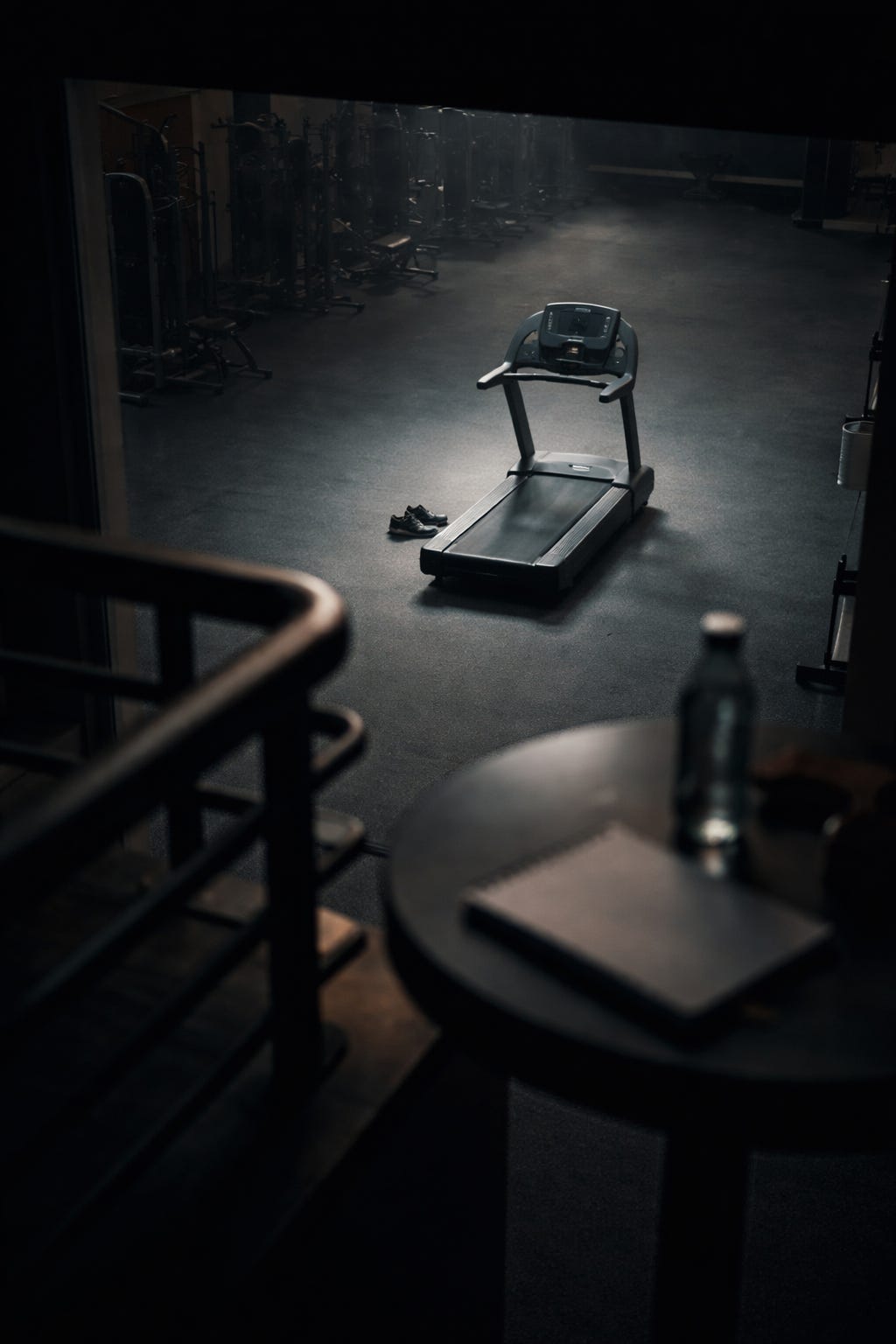
There is a man on the treadmill next to mine. He hasn’t looked at me. He won’t. But I already know what I’m not going to watch.
I’d had something pulled up. Something I wanted to see. And then he got on the machine and I closed it, not because he was looking, not because I thought he’d care, but because the possibility of his noticing had already reorganized the situation. He arrived and I adjusted. Not my body. My attention. I moved it up one floor, to the place where I can observe what I’m doing rather than simply do it, and from there I spent the next forty minutes managing the impression of a man who was looking at his own phone the entire time.
This is not about him. That’s the whole point.
Bentham designed a prison where every cell faced inward toward a central tower. The tower might be empty. The prisoner couldn’t know, so the prisoner behaved as though it were occupied. Foucault made this into a theory of modern power: the institution saves the cost of watching because the watched do the work themselves. That analysis is correct and also slightly beside the point now, because it still imagines an original coercion, some structure that produced the habit. What’s harder to explain is how the habit runs without the structure. How a person stands at a treadmill in a mid-sized gym in a small city, watched by no one who cares, and still can’t watch what he wants to watch. The guard was never in the tower. And yet here we are.
At some point the second-order self stopped being a response to pressure. It stopped being a response to anything. It just became where I live.
I have spent a significant portion of my professional life in rooms where decisions are nominally made. Briefings, working groups, the kind of meetings that generate summaries and the summaries that generate follow-up meetings. I have learned to be useful in these rooms by becoming a sufficiently blank surface that people feel comfortable projecting their thinking onto. I nod. I ask clarifying questions that let people hear themselves. I do not introduce friction at the wrong moment.
I am not present.
I left some time before the meeting started, relocated to the second floor, and from there I watch the proceedings with a mild, managerial interest. What is the room’s emotional weather? Who needs to feel heard? Where is the status competition running underneath the stated agenda? These are not useless observations. They are sometimes exactly what the situation requires. But they are not thinking, or not the kind I mean, which is context-responsive to ideas rather than to mood. Thinking and mood-management are different operations. They compete for the same attention. And mood-management, in these rooms, wins almost every time because the cost of failing at it is immediate and visible and the cost of failing at thinking is diffuse and slow and doesn’t show up in the summary.
What I do instead of thinking, in those rooms, is to become a very attentive mirror. People leave feeling understood. They also leave having encountered a surface rather than a mind. I have become skilled at a thing that requires my absence. I have been told, more than once, that I am a good listener. I have noticed that what this usually means is that I did not interrupt, and that I smiled in the right places, and that I asked one question that let the person finish a thought they’d already been having. The credit for this lands on me. The thinking was theirs.
The habit doesn’t stay where you put it.
What you watch has become a kind of statement. What you search for. What you linger on. Someone is always building a file. Usually it’s you. The result is that attention has become a kind of speech. To watch something is to say something. To linger is to declare. Nothing is just done anymore. Everything is also data in a case about you that is always being filed, by you, whether you mean to or not.
The reasonable response to this is to begin managing your attention as carefully as you manage your speech. To treat your own noticing as a performance subject to review. To ask, before you look at something, not just whether you want to look at it but how the looking will read.
And the thing is, it’s not wrong. Given what the situation actually is, this is the sensible move. That’s what makes it so hard to get out from under.
Because what gets damaged is not anything you can easily measure. It is something more like unselfconsciousness. The ability to be inside an experience before you are outside it looking in. I once read Simone Weil on attention and found myself unable to argue with her even though her frame was prayer, which is not my frame. She thought real attention required suspending your own agenda completely, that you had to empty yourself out before you could actually see what was in front of you. I kept thinking about that word, emptying, and how it described something I used to do without knowing I was doing it, and how I do it less now, and how the loss is so gradual it mostly registers as a vague sense that certain experiences have gotten thinner.
You can’t be surprised from the second floor. You can see the surprise coming and watch yourself react to it and file that away too.
I’m not going to end this with a program. Attention practices, digital detox, structural reforms to data collection. Those endings exist and they’re not wrong but they resolve something that I think should stay unresolved, which is the question of whether what I’m describing is reversible or whether we are simply people now who are not quite all the way present anywhere, and whether we know it.
I can feel the first floor sometimes. A long run on a trail with no one around, far enough in that the second-order self has gotten bored and wandered off. Or a conversation that’s moving fast enough that I forget to monitor it, where the ideas are going somewhere unexpected and I’m just inside the thing, responding. Those moments feel denser than ordinary time. More there. Like arriving somewhere I hadn’t known I’d left.
I don’t know what the ratio is, for most people, between floors. I know mine has shifted. I know the second floor is where I spend most of my professional life and more of my personal life than I used to, and that I became good at living up there by practicing a skill that was really useful and that I would practice the same way again. That’s the part I find hardest to sit with. Not that I was coerced into it. That I was incentivized into it incrementally and reasonably, in small steps that each made sense, until the aggregate was something I wouldn’t have chosen if I’d seen it whole.
There’s a man on the treadmill next to mine. He’s gone now. I stayed on the second floor for a while after he left, out of habit, watching myself watch the thing I’d wanted to watch in the first place.
after reading this post, Im questioning EVERYTHING about our previous interactions ...