
You Don’t Solve Problems Once
Shifting persistence

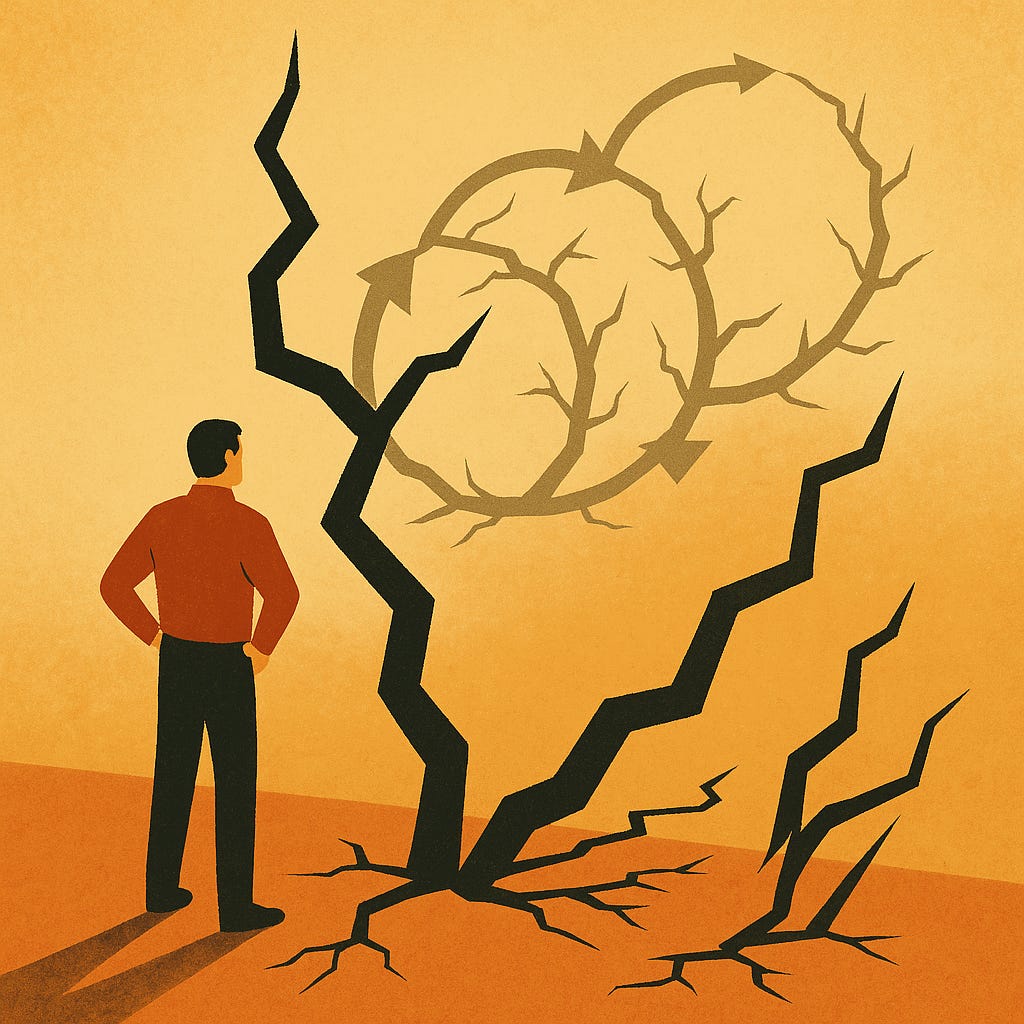
We want problems to end. That’s the story we long for. A neat closing scene: the treaty signed, the law passed, the vaccine discovered, the new technology switched on with a flourish. The photo op captures smiling faces, the applause rings out, and the cameras click like exclamation points. The problem is finished. We can move on.
But life rarely grants us that kind of closure. Problems do not vanish simply because we’ve declared them over. They return, in smaller guises or larger ones, sometimes subtly altered, sometimes unrecognizable at first glance. They twist, adapt, and reappear. Over and over and over. The moment we look away, they slip out of their restraints. What we thought an ending was only intermission.
The fantasy of permanence is powerful, but it’s dangerous. It blinds us to the reality that challenges are dynamic and often most treacherous just when we’ve begun to relax. The truth is disquieting but also clarifying: you don’t solve problems once. You negotiate with them, you manage them, you hold them in check. Sometimes you push them back for a season, sometimes for a generation. But the work always resumes.
Why is this so? Partly because the problems that matter most are tangled things. They don’t sit in a corner waiting patiently for us to fix them; they’re woven into the fabric of economies, cultures, technologies, and ecologies. Tug at one strand and another tightens. Address one symptom and the balance shifts elsewhere. A solution doesn’t end the problem; it changes its shape.
It’s also because our idea of what “solved” means never stands still. Eradicating smallpox once looked like humanity’s final victory over disease. Yet almost as soon as the disease was gone, expectations shifted. No longer was survival enough; we wanted equity, resilience, preparedness for the next outbreak. Each victory raises the bar, transforming yesterday’s triumph into today’s baseline. Problems re-emerge not only because they persist, but because we ask more of ourselves.
And problems push back. They are not lifeless obstacles but responsive forces. Pathogens evolve resistance. Criminals find loopholes. Technology introduces risks as quickly as it dispels them. Every intervention provokes a counter-response. Stability becomes an arms race rather than a final state.
This is not abstract. It is the texture of the present. Artificial intelligence is not a puzzle we will solve once but a system we will be negotiating with indefinitely. Efforts to make it safe work will work for a while, until the next model arrives with new capacities and new risks. Online life, too, shows this truth. Every clever tool designed to clean up disinformation or harassment works for a time, until bad actors adapt and the cycle begins again. Even economics (so often imagined as a science of neat balances) proves restless, its great settlements dissolving with each new shock, each new generation of expectations.
Nature offers the same lesson in sharper form. Your body regulates itself not by fixing things once but by constant correction—sweating, shivering, adjusting in a quiet rhythm that never stops. Evolution itself is not a story of final victories but of endless adaptation, prey and predator locked in a race with no finish line. Even our machines echo this. Autopilot does not set a course once and coast; it keeps adjusting, responding, correcting. Stability everywhere is dynamic, not static.
Here lies a deeper danger: the problems themselves are not always what undo us, but rather our insistence that they are or, even, can be gone. Institutions lose legitimacy less because challenges endure than because leaders pretend they don’t. People can accept that the world is restless; what they cannot accept is being told to believe in stillness when their own eyes register motion.
When governments declare a crisis over while citizens still feel its grip, trust weakens. When corporations insist a scandal has been “resolved” even as echoes of it surface again, credibility erodes. When platforms assure their users that harassment or abuse is “behind us” while familiar patterns persist, confidence crumbles. The denial of persistence corrodes more deeply than persistence itself.
Legitimacy, then, rests not on delivering final victories but on being visibly responsive. Citizens do not expect perfection, but they do expect engagement. They expect to see leaders and institutions acknowledge that problems are stubborn and to watch them wrestle, adjust, recalibrate. Trust survives not because problems disappear but because the work continues.
Unresponsiveness is fatal. A pothole left unfilled is a nuisance; a mayor who insists the streets are flawless while cars jolt through craters invites ridicule and resentment. A health system that admits disease is a permanent opponent can still command confidence; one that proclaims the danger past while new infections rise soon loses authority. Acknowledging the ongoing nature of problems is not weakness—it is the condition of trust.
So how do we live in a world where nothing stays solved? Perhaps the answer is to stop asking for permanence and start asking for responsiveness. To accept that resilience is not about locking down challenges forever but about adjusting to their next form. To design our institutions for iteration, with renewal and revision baked in rather than resisted. To shift our culture away from conquest and toward stewardship, treating problems less like enemies to be slain once and more like conditions to be tended with patience, care, and humility.
And perhaps most importantly, to prepare ourselves for permanence in the work rather than in the solution. If we raise generations to believe crises will be erased once and for all, we sow disappointment and cynicism when they inevitably return. But if we learn to expect ongoing effort, we can find hope in the very act of persistence. A resurfacing problem does not prove failure; it proves the world is alive, and we are alive to meet it.
“You don’t solve problems once.” It sounds grim at first, like a sentence to endless toil. But in another light it is liberating. It means we do not need to wait for a perfect, final victory to find meaning in the work. We can honor each step forward, each reprieve, each partial gain. The task is not to close the book but to keep writing the pages.
The better metaphor is not a puzzle but a fire. You do not strike one flame and walk away. You tend it, feed it, guard it against the wind, and pass it on. The flame persists, and so does the need to care for it. Challenges, like fires, cast shadows but also light. Tending them is what keeps us warm, keeps us human.
The fact that problems never stay solved is not a tragedy. It is a reminder that history remains open, that each generation inherits the work and adds its own effort to the long chain of attempts. Our labor does not end with resolution; it endures with care. In that continuity lies resilience, legitimacy, and, perhaps most of all, hope.