
Picking Up the Pieces
An opportunist’s guide to making good use of tarnished things

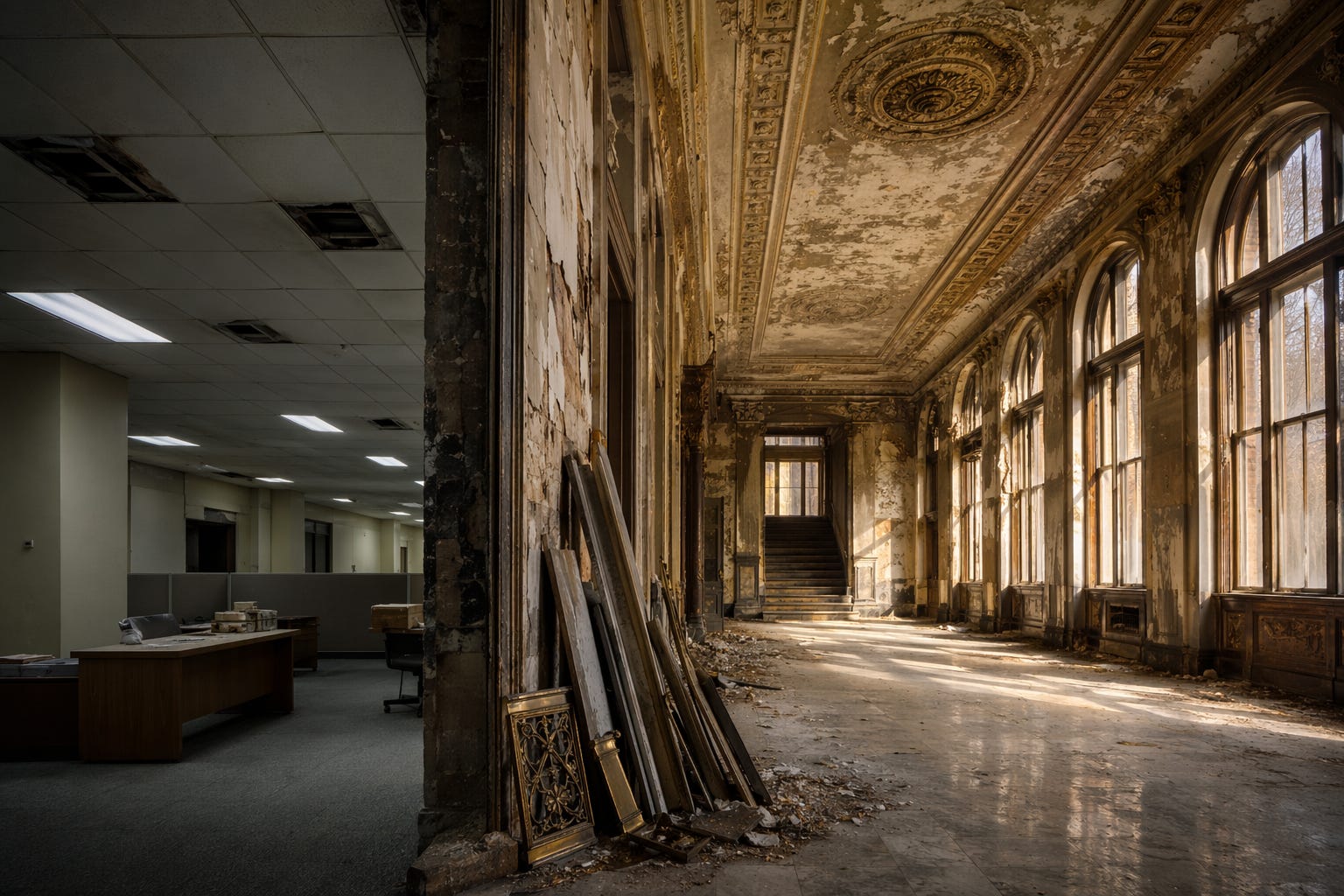
There is a kind of building you see in older American cities, the kind that went up in the 1910s or 1920s when someone believed something was permanent. Limestone, usually. Bronze fittings. A lobby with a ceiling you were supposed to look up at. These buildings get sold at some point, and the new owners strip the bronze for scrap and drop a drop-ceiling over the plaster and put in fluorescent lights, and for thirty years the building looks like a dentist’s office. Then someone younger buys it cheap, pulls down the drop-ceiling, and finds the plaster intact. The bronze is gone. But the plaster is there, and the proportions are there, and the windows are twelve feet tall.
I think about this a lot. The building wasn’t reverent. Someone made a calculation. The bronze was valuable and portable; the plaster was expensive to remove and not worth much. What survived was what no one bothered to steal. A lot of what’s worth having in the world got there that way.
I want to argue for an uncomfortable posture. Call it mourner’s opportunism. You find a thing that has lost its shine or collapsed outright, and you sit with what went wrong long enough to understand it, and then you pick up the pieces that are still doing work and you use them, and you do not pretend the collapse didn’t happen, and you do not pretend your interest is pure. The opportunism is real. The pieces are cheap because picking them up associates you with the wreckage, and most people would rather wait for the next pristine thing. The pristine things are mostly pretending.
I am going to talk about crypto, the civil service, and public health, in that order, because the order is from embarrassing to painful. From distant to within me.
The Blockchain
Crypto had a bad decade. The speculative manias, the rug pulls, the Super Bowl ads, the earnest young men explaining that they had solved money, the exchanges that turned out to be Ponzi schemes run by people in polo shirts, the NFT boom and its art-world corollary, which involved six-figure JPEGs of cartoon apes and the sincere claim that this was culture. FTX. Celsius. Terra. The list is still being added to. Whatever crypto was supposed to be, a lot of what it turned into deserved what happened to it. I watched friends lose money. I watched smarter friends make it and then lose it slower. The whole thing had the quality of a casino in which the house was also on fire, and everyone kept playing because the flames cast fascinating shadows.
Underneath all of that, there is a small number of technical primitives that keep quietly reappearing in serious infrastructure. Content addressing: you identify data by a hash of its contents rather than by where it lives. Append-only logs: you record events so that quietly editing the past becomes impossible without everyone knowing. Cryptographic commitments: you prove to someone who does not trust you that a given piece of data existed at a given time. Verifiable computation: you run a calculation and hand someone a short proof that the calculation was done correctly.
None of these make anyone rich. They are plumbing. They are going to matter enormously for the governance of AI systems, because model provenance and training data attestation and tamper-evident audit logs are going to be the questions that determine whether automated decision-making can be held to any standard at all. The answers were developed mostly by people who wanted to build untraceable money, and who produced, as an accidental byproduct of their actual project, some of the only tools we have for making accountability technically enforceable rather than merely rhetorical.
This is the irony I cannot stop thinking about. The people who wanted to build a world in which authorities could not trace anything built the tools that authorities will use to prove what they did. The libertarian dream generated its own best refutation. The escape hatch turned out to be the receipt printer.
Picking up these pieces means reading the technical literature without adopting the politics, which is harder than it sounds because the politics are baked into the documentation, the conferences, the vocabulary. It means crediting engineers whose subculture you would not want to be seen dining with. It means refusing to rebrand the primitives into something that sounds more respectable, because the rebranding is how you lose track of where the ideas came from and who else is working on them, and also because the rebranding is cowardice. The pieces are cheap because their origin is embarrassing. You pay for them with embarrassment. That is the deal.
The Civil Service
There was a thing the American civil service used to be, roughly before 2016, and I want to describe it carefully because the cartoon versions are useless. It was not a utopia of competence. It was not a hive of deep-state conspirators. It was a professional culture, distributed across hundreds of thousands of people, organized around a few tacit commitments: that you served the office and not the person holding it; that your job was to provide your best technical judgment and then implement lawful direction whether or not you agreed with it; that institutional memory was a load-bearing asset and you had a duty to transmit it; that the work was dull most of the time, and the dullness was a feature, because excitement in government usually means somebody is about to get hurt.
I am going to stop hedging. This culture is taking its last breathes and I do not know if it can be brought back. The mechanisms that transmitted it were informal, apprenticeship-shaped, dependent on a stable enough environment that a young analyst could spend five years watching an older one read a regulation, and those mechanisms have broken. The people who carried the culture are retiring, in some cases being pushed out, and the replacements are being hired into an institution that no longer consistently teaches what the institution used to know. You cannot run an apprenticeship in a building that is on fire.
What this culture did, when it worked, was absorb politics. A career civil servant with twenty years in the agency could watch five administrations arrive with different priorities, implement each set of priorities within the bounds of the law, and preserve the underlying capacity of the agency across the transitions. The civil service was a kind of flywheel. The politicians spun it one way and then the other, and the flywheel kept the country from coming apart at the seams. Remove the flywheel and every administration starts from zero, and the distance between administrations becomes the only thing the government is capable of expressing.
I know and appreciate people who still do the work the way the work was meant to be done. The person who notices that a regulation is going to have a consequence nobody intended and quietly writes the memo that fixes it. The person who maintains the dataset that five agencies depend on and that nobody has budgeted for. The person who trains the next generation in habits of mind that cannot be written down, because if they could be written down they would have been, and the absence of the writing is itself a piece of information about what kind of knowledge this is.
The opportunism here is that the work is available, right now, and most people have written it off, and the people doing it have almost no competition. The cost is that you are doing it without the scaffolding that used to make it understandable, which means that most of the time, nobody will know what you did. You will write the memo and the memo will work and the consequence will be averted and the averted consequence will never show up in any metric, because averted consequences do not show up in metrics, which is one of the reasons the culture is dying in the first place. You will be compensated in the coin of knowing that you did the thing. If that coin feels like enough, you are the kind of person the work needs. If it doesn’t, fair.
What you are doing, under these conditions, is maintenance and transmission. You are keeping the practice alive so that if the scaffolding can ever be rebuilt, if we even want to rebuild it, the knowledge of how to rebuild it has not vanished with the last generation that had it. This is not nostalgia. Nostalgia wants the old thing back. The practice is not coming back in anyone’s career timeline I can see. You are doing the work because the work is worth doing, and because the alternative is that it stops, and when things like this stop they tend not to restart.
Public Health
I have been circling this one and I should stop.
Public health as a field lost its public. The specific mechanism was that the field, under the most intense scrutiny it had received in a century, was unable to separate its scientific claims from its value claims, and the public correctly noticed, and the correction is still running. The school closures. The shifting mask guidance without acknowledgment of the shift. The tone, especially the tone, the tone that said we are the grown-ups and we will tell you when you can see your dying mother, the tone that survived contact with the facts because the tone had stopped being about the facts a long time before. I am not going to pretend I was not part of this. I was not making the decisions, but I was in the rooms next to the rooms, and I knew and I did not say, and neither did most people I know, and the cost of not saying is now being paid by a field that contains some of the most committed public servants this country has, most of whom did not make those decisions either and who are now carrying the consequences anyway.
The field is defensive and I understand why. I also think the defensiveness is finishing what the original failures started. Every time a public health professional goes on television and explains that the public simply misunderstood, or that the problem was messaging, or that the critics are bad-faith actors, the field loses another decade of legitimacy it did not have to lose. I’m overexaggerating, I hope, but it does feel like decades lost.
Some of the critics are bad-faith actors. Many of them are not. The ability to tell the difference requires a posture the field has not yet found, a posture in which you can say we got it wrong here and we got it right there and here is how you can tell, and you can say this without collapsing into apology or stiffening into defense, and very few people in the field have figured out how to hold that posture in public, and I do not blame them because I have not figured out how to hold it either.
Here is what I want to pick up. Public health as a project is older than the CDC and older than the germ theory of disease. It goes back to sanitary reformers and cholera maps and the slow argument that sewage was a public problem rather than a private one. The project is that disease happens to populations as well as to individuals, that the statistical imagination is necessary for seeing this, that tradeoffs between competing goods are unavoidable and should be made in the open, and that some version of collective action is required for problems that individuals cannot solve alone. The project is necessary. The project is, in fact, more necessary now than it was six years ago, because the problems the project exists to address have not gone anywhere, and the capacity to address them has.
The institutions stewarding the project are damaged and some of them will not recover. The project is portable. It does not require the current institutions and it did not originate with them. Picking it up means making the population-level argument in front of audiences that have stopped granting the institutional authority that used to back it. It means making the tradeoffs explicit, including the ones the field has been reluctant to own. It means learning to argue without the robe. The rhetorical moves that worked when the field was trusted will not work now, and the work of rebuilding trust is a different kind of work than the work of exercising it, and most of the people who were good at the second kind of work are going to have to learn the first kind now, in public, while being yelled at.
The opportunism is that this work is available to people who were not making the decisions and who are willing to say so, and to people who were and are willing to say that too. The cost is that you will be associated with a field in the middle of the worst stretch it has had in living memory, and the association will follow you, and some of the people you are trying to help will not want your help because they are done with anything that smells like the thing that hurt them. You do the work anyway, because the project is older than the failure and will outlast it, and because if the project dies the next pandemic does not know and does not care.
What They Share
A technology that became a scam. A professional culture that eroded. A field that lost its public. The pattern is that each of them went through a stretch in which certain shortcuts became tacit and certain criticisms became unsayable, and then each of them broke, partly from the accumulated internal failures and partly from exogenous pressure that a healthier version might have withstood. Each of them left, in the wreckage, pieces that were load-bearing the whole time. The pieces are cheap. The reputational cost of picking them up is real.
All three are, at some level, about expertise. Crypto was an attempt to route around credentialed expertise that produced its own credentialed class with its own failures, and the pieces worth keeping are the ones the failed class built before it failed. The civil service is a kind of public expertise that depended on conditions that no longer hold, and the pieces worth keeping are the ones still in the heads of people who have not yet retired. Public health is a direct collapse of expert authority in a domain where expert authority seemed stable, and the pieces worth keeping are the ones that predate the authority and do not need it.
I am not going to tell you this adds up to a program. It does not. I am going to tell you that the people who do useful work in the next decade are going to be, disproportionately, people who were willing to pick up tarnished things and be seen doing it. The willingness is the whole thing. Most people are not willing. The pieces accumulate, waiting.
I do not know if what can be built from the pieces will be as good as what fell. I doubt it. I suspect the next decade will be worse than this one and I suspect the decade after that may be worse than the next. But the useful pieces are still there, tarnished, diminished, but sitting, waiting to be used by those who would prove my suspicions wrong.
"Averted consequences don't show up in metrics. That's one of the reasons the culture is dying." Your line here explains why the most important work in any organization is invisible.
The flywheel metaphor for the civil service is one of the best descriptions of institutional coordination I've read. Remove it and every administration starts from zero.
Just subscribed. Can't wait to read more of your work, Joe.